


 Back
Back





What trio of letters do you most associate with golf?
P.G.A. (as in "Tour" and "of America") is probably number one, with T.P.C. in a distant second. Give it a couple years, though, and C.B.D. might be giving it a run for its money. Despite a lot of players and a distinct lack of clarity and regulation, it's a multi-billion-dollar behemoth that seems to explode in size every year. It could generate more than $20 billion annually by the middle of the decade.
The proliferation of CBD products in the golf industry is part of greater efforts to market and sell CBD products. The stuff is everywhere, from convenience stores to smoke shops to cosmetics stores and restaurants. CBD products are even appearing in golf course pro shops, right next to gloves and golf balls.
At the 2019 PGA Merchandise Show, there were six exhibitors with some form of CBD product. At the 2020 Show, that number was 19. PGA Tour players are starting to rep CBD companies like Medterra (Lucas Glover, Charley Hoffman) and cbdMD (Bubba Watson). Amateur golfers take cues constantly from the professional tours, and so CBD has staked a claim as a wellness wonder within the golf industry.
What is CBD?
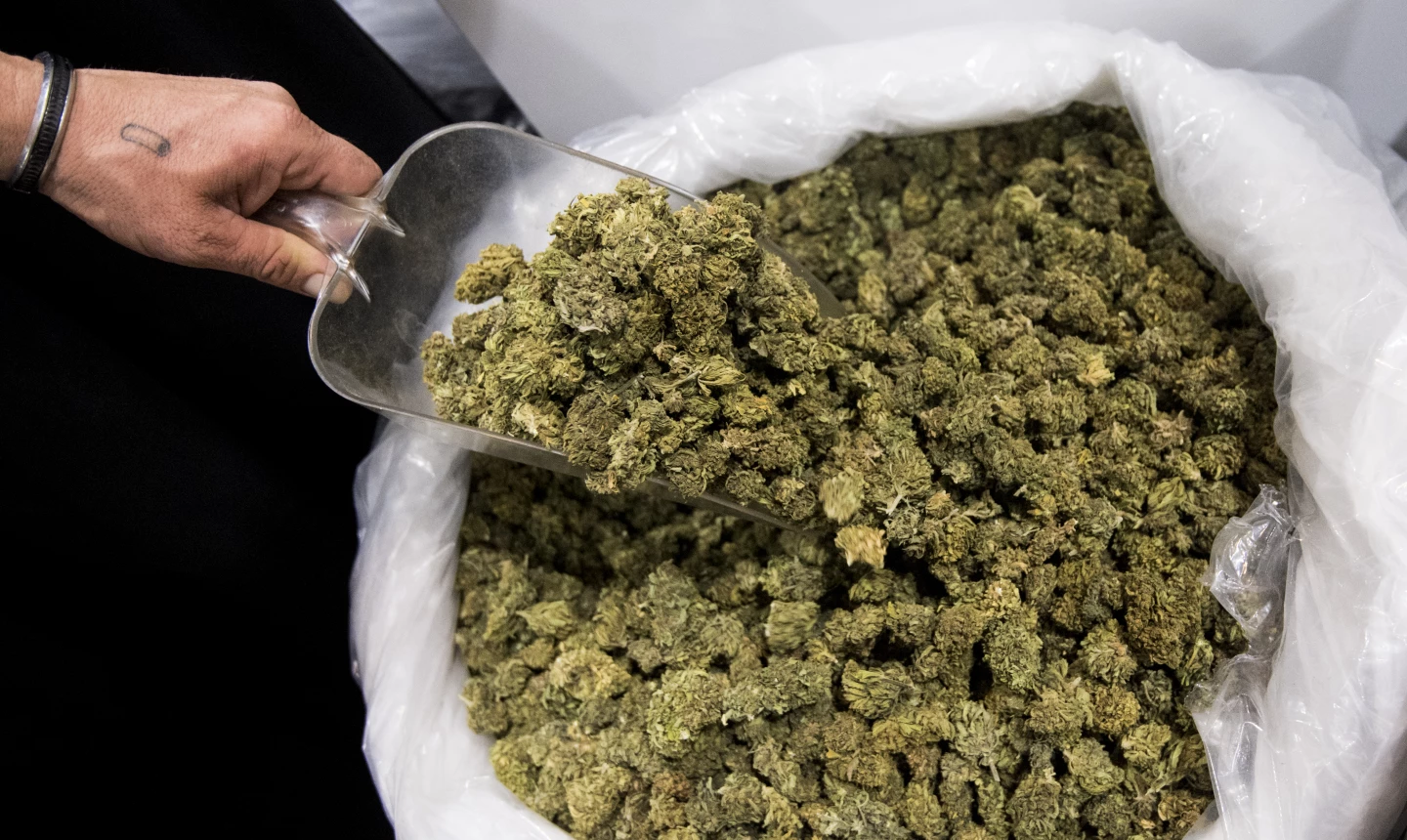
“CBD” is an abbreviation of cannabidiol, which is a substance derived from plants of the genus cannabis. These include cannabis indica and cannabis sativa, both of which can be converted into psychotropic drugs.
The substance in cannabis that makes people feel high, however, is not CBD. It’s THC, or tetrahydrocannabinol. The presence of THC is what separates the drug form of cannabis best known as marijuana from legal, “industrial” hemp, which is a cultivated cannabis plant that possesses less than 0.3% of THC. This is the type of cannabis that CBD producers use.
Even though it doesn’t create the mind-altering effects of THC, CBD is regarded as having several potential health benefits. It has exploded in popularity due to a few key events in the last few years.
The first came in 2013, when a CNN aired a documentary hosted by Dr. Sanjay Gupta called “Weed" that featured Charlotte Figi, a five-year-old girl suffering from epileptic seizures as a result of Dravet syndrome. Her parents treated her with high-CBD, low-THC cannabis oil and they and her doctors noted a subsequent reduction in her seizures. This prompted the Colorado-based makers of the oil to rename their product Charlotte’s Web.
Since Figi’s story came to light, hundreds of companies have developed thousands of products that revolve around CBD as a wellness-promoting substance. The rush into this business was spurred first by a 2014 Farm Bill that created a Hemp Farming Pilot Program, which became the Hemp Farming Act as part of the 2018 Farm Bill. Now, 47 states have legislated that it is legal to grow hemp.
Can CBD help golfers feel and/or play better?
I spent part of the 2020 PGA Merchandise Show talking to various CBD product developers and sales people, trying to get a handle on this trend. As you’d expect from a trade show, everyone was sure their product was the best. Each of them had figured out the best formulation and approach to helping people - especially golfers - feel the full benefits of CBD.
But the billion-dollar question: does CBD work?
After spending some time both talking to CBD manufacturers and trying their products, the best answer I can come up with is "maybe," or "it depends." I know, that's not very satisfying. But there are important reasons why it's not possible to be definitive about CBD, and if you have any interest in trying such products out, you need to consider just how murky an industry it is at the moment.
In speaking to several different CBD companies, I heard a lot of bold statements. One evangelist I spoke to believed so deeply in cannabis plant extracts that he claimed hemp-based health products could replace 80% of all pharmaceuticals in the next decade or so.
Mostly, though, it was a word-soup of terms that all seem to have something to do with how effective a CBD product might be. The key to differentiating among these companies is a trio of terms - "full-spectrum," "broad-spectrum" and "isolate" - that describe the actual nature of a hemp derivative in a given product.
Isolate, in layman's terms, is pure CBD, separated out (i.e. isolated) from all other nutrients and compounds a hemp plant contains. Most of Medterra's product line is based on isolate, partly because it enables Medterra and some other companies to proudly declare their products THC-free. This is meant to alleviate concerns on the part of customers who fear using a CBD product and subsequently failing a drug test due to the presence of some amount of THC.
"We extract only the CBD from the hemp plant, and then pair it up with our other active ingredients to deliver the highest-strength CBD at really the most affordable price per milligram in the market,” said Greg Moore, Medterra's vice president of sales. Those other ingredients can include melatonin, which goes into Medterra's ingestible sleep-aid supplement, or caffeine and Vitamin B6, which are part of its Good Morning supplement, along with CBD isolate.
Medterra has also introduced some broad-spectrum products into its offering. These contain some other natural hemp compounds in addition to pure CBD, but still leave out THC.
Several of Medterra's smaller competitors take a different approach. They use full-spectrum CBD, which means they leave various other compounds in their products in addition to CBD. That includes THC, though always below the 0.3% legal limit, as well as terpenes, flavinoids and other cannabinoids. Proponents of full-spectrum CBD products include the New York-based High Falls Hemp, Asheville Botanicals and the Rhode Island-based Bogey Free CBD. Their justification for including some THC as well as the other ride-along compounds is known in the industry as the "entourage effect," and holds that those other substances work together to make a more potent product than just CBD alone.
“We’re trying to give you everything that Mother Nature [put] in the plant, working in unison," said Jim Stahl, CEO of Asheville Botanicals. "It provides a more efficacious product, it’s a more natural product and, as a result, you don’t have to use so much CBD.”
Isolate is "just not as effective as all of the [full-spectrum] components working together," said Vincent Posca, Bogey Free CBD's director of research and development. And speaking specifically on the trace amounts of THC that legal hemp still carries, he said, “the highest quality product has THC in it because THC is one of the most potent and powerful anti-inflammatories, even more so than CBD."
Standing by Medterra's isolate-based formulas, Greg Moore said "Some consumers are going benefit and have a positive reaction to all those cannabinoids and terpenes. Other consumers are seeing incredible benefits with pure CBD isolate."
Which brings us to the question of benefits, both to golfers and the general public.
What health benefits can CBD provide?
If you want direct answers as to what CBD products can do for you, you will have to look elsewhere than the companies whose products you may buy.
Companies themselves are not allowed to make any direct claims because none of their products have been approved for such specific used by the Food and Drug Administration (FDA). Only one CBD-based medication has FDA approval: Epidiolex, which is used to treat seizures of the sort Charlotte Figi suffered from. Two synthetic THC-based medications are also FDA-approved, but the broader CBD industry will likely have to wait several years before they can tout specific benefits tied to their products because more research and studies are necessary before the FDA can rule affirmatively.
So for now, it's something of a gold rush - or green rush, more like - to market CBD to the world, including its millions of golfers. There are several fly-by-night operations mixed in with the more serious producers.
“We can’t talk about the benefits," said Barney Stacher, chief revenue officer of High Falls Hemp. "But what we can tell you is that CBD is known to create equilibrium, or homeostasis, in the body, a sense of balance in the body. We can’t talk about anything else."
“We can’t use claims, technically, so we don’t put claims on the label," said Vincent Posca of Bogey Free CBD. "But what people are reporting when they use CBD is lowering inflammation in [the] body.”
"[Customers] feel like it’s helping them rest," said Medterra's Greg Moore. "They’re finding that this product’s helping them. It’s allowing them to potentially play more golf. People that have pain and could only play once or twice a week are now finding themselves being able to play more rounds. People that could maybe only play nine holes are now able to play 18." Testimonials about CBD products claim benefits in combating inflammation, anxiety, depression and sleeplessness, among other maladies.
“There are a lot of kids who are taking their weed, mixing it in moonshine, putting it into a popcorn popper and they're making their own sauce and saying ‘Hey man, I made my own s--t!’" said Jim Stahl, adding that there is no strict prohibition on such tactics. “There’s not a regulatory group that can say ‘yea’ or ‘nay’ on what we’re doing right now."
In the midst of this Wild-West early-days scenario, the best approach for consumers is to do diligent research about the brands whose products they're considering using. Vendors I interviewed agreed that if there's not a QR code linking to a Certificate of Analysis on a tincture or topical bottle, steer clear.
CBD products and pitches for golfers
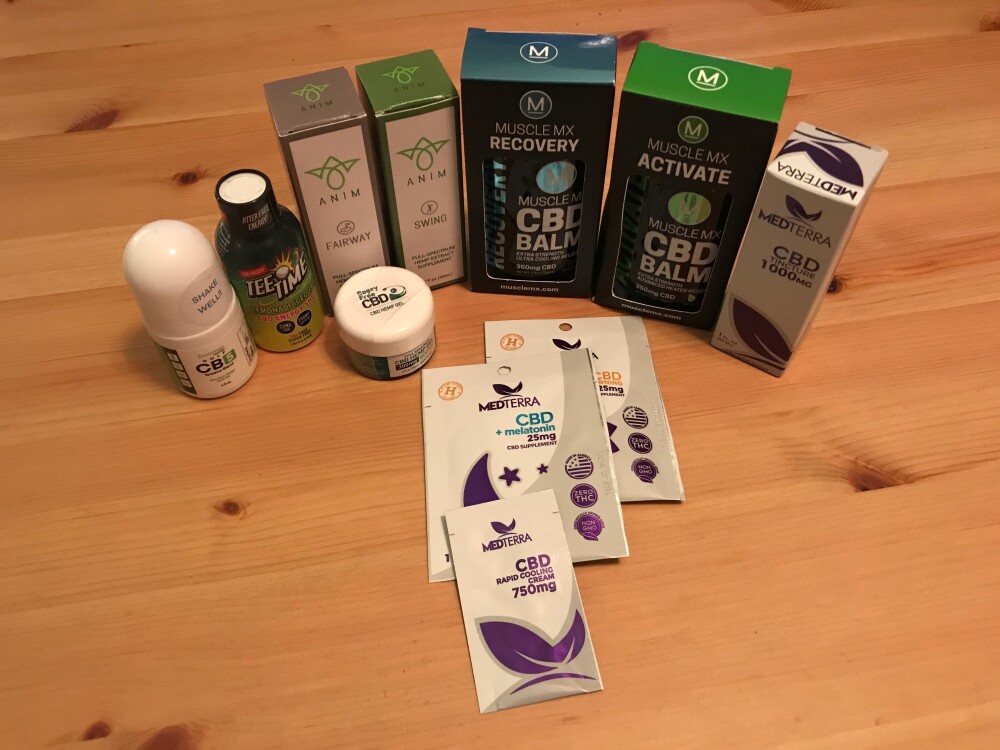
The fad-side of the CBD industry has put those three letters into some unlikely products like hair pomade, toothpicks and toilet paper. It's in all kinds of food products, from potato chips to smoothies. For golfers, there are two main classifications of CBD product to be aware of: ingestibles and topicals.
Though caplets are not uncommon, the main form of ingestible CBD products is in the form of oil tinctures. These brown-glass bottles often have built in dropper-caps, and users squeeze a quantity of the tincture under their tongues, hold it there for 30 seconds to a minute and swallow. Introducing the tincture sublingually is meant to get it into the bloodstream faster. Medterra's isolate tinctures range in concentration from 500 ($35) to 1000 ($56) to 3000 milligrams ($133) in a 30-milliliter bottle.
High Falls Hemp's full-spectrum tinctures come in potency levels from 300 up to 3000 milligrams, ranging in price from $35 to $200.
Eschewing the potency ratings and sticking with proprietary formulations, Asheville Botanicals makes two golfer-targeted tinctures under their ANIM sub-brand: their Fairway formulation for pre-round calm and their Swing formulation for post-round recovery. A 30-milliliter bottle costs $69, while their Restore product is $99 per similar-sized bottle.
Topicals include all manner of salves, balms, creams and other CBD-infused substances that are meant to be rolled onto the skin. Some CBD proponents are skeptical of their effectiveness, but Kami Day, co-founder of Muscle MX, is a fan of topicals, both her broad-spectrum (no THC) Activate roll-on before and Recovery for after physical activity ($40 for each). “I think a topical is probably the most effective way to treat any kind of pain," she said, speaking from her own experience. "If you have a pain in your hip, you apply it to your hip and you feel instant gratification.” As for ingestibles, she said, “Is it super-effective for me on a personal level? No, but I’ve seen what it does for others.”
Companies like Medterra supplement their tincture offerings with topicals, as do Bogey Free CBD and Asheville Botanicals. On Duty CBD is a company owned by U.S. Military veterans, with veterans also involved in the farming of the hemp that goes into their ingestible and topical products, as well as gum.


Comments (16)
I personally take full-spectrum CBD every day. The research shows full-spectrum is best long-term. Obviously, I wouldn't take it if I was being drug tested because even that minute amount of THC can trip you up. That 's ridiculous you can take addictive pharmaceuticals with no problem. Anyway, I've personally spoken to two seniors in Virginia, Mr. and Mrs. Davidson, who golf and they swear by their full-spectrum CBD lotion for their arthritis and back pain. They say their friends are always asking to use it after golfing. It's from the same company I've used and run by a MD who specializes in cannabis and CBD, formulates everything, and is lab tested. I guarantee 100% that those who say CBD is crap after trying it either bought worthless crap from a gas station or from somewhere else.
I've been using the cbdMD "Freeze" on my shoulder/neck that locks up on me on the course. I get drug tested regularly at work and this product is NO-THC so it's perfect and works wonders on my trouble spots while on the course and afterwards. Oh also Bubba Watson uses it so I'm convinced I'll be as good as him in no time if I keep using it!
I personally take full-spectrum CBD every day. The research shows full-spectrum is best long-term. Obviously, I wouldn't take it if I was being drug tested because even that minute amount of THC can trip you up. That 's ridiculous you can take addictive pharmaceuticals with no problem. Anyway, I've personally spoken to two seniors in Virginia, Mr. and Mrs. Davidson, who golf and they swear by their full-spectrum CBD lotion for their arthritis and back pain. They say their friends are always asking to use it after golfing. It's from the same company I've used and run by a MD who specializes in cannabis and CBD, formulates everything, and is lab tested. I guarantee 100% that those who say CBD is crap after trying it either bought worthless crap from a gas station or from somewhere else.
I've been using the cbdMD "Freeze" on my shoulder/neck that locks up on me on the course. I get drug tested regularly at work and this product is NO-THC so it's perfect and works wonders on my trouble spots while on the course and afterwards. Oh also Bubba Watson uses it so I'm convinced I'll be as good as him in no time if I keep using it!
I'm based in the UK and I'm using Golfer's CBD in the UK. I've been getting some amazing scores recently and feeling like there is less stress in my game, so it's been a Godsend for someone like me who takes competition play too seriously at times. I think this is going to become massive in the UK too.
Great article, super informative! I've found a lot of success using CBD especially for sports related aches and pains. I use a company called Eden's Herbals. I like them because it's all grown and made in the US, the price is really good, and most importantly it works. If you haven't heard of them I'd highly recommend checking them out! www.edensherbals.com
Like Alan below I live in Washington State. Medical marijuana was available long before even recreational. I have used weed going back to the '60's but not really until about 2008 for medical reasons, bone spurs in my neck. Can be very painful. Than a few years ago a herniated disc in my lower back. I have found for pain regular pot with both THC and CBD works best. When playing golf I can maintain a "mild buzz". Sort of like guys drinking a couple of beers. The pot works better than any over the counter pain meds like Advil or Tylenol. Opiods are just out of the question. I am in my 70's, walk with a pushcart (best invention yet) and until this CV 19 played 9 about 5 times a week. I have used straight CBD and I believe it is pure hype. Just a way to make a buck in areas where even medical marijuana is banned or for people who believe pot is evil.
I'm surprised the article didn't provide more focus on the CBD products Tour players use confident that they (no THC) pass a random drug test ,not risking disqualification from a tournament. Also outside lab testing assuring other harmful pesticides,heavy metals,ect. are not present in the product.
I have had a personal experience with CBD. It reduced the pain and inflammation in my low back and allowed me to play golf and other sports. My low back pain was so bad I could barely get out of bed let alone bend over or swing a club. After about 30 days my inflammation and pain was virtually gone.
I am such a believer that I started a company selling CBD products.
Spice Wellness LLC
https://premiumcannas.com
Swing by and check out our premium CBD brands. All with CoA’s.
Living in WA state, I think plain old weed is just as effective and a lot cheaper. I vape flower or oil concentrate after playing and it helps with overall pain relief big time. I’m 71 and walk with pushcart and know I couldn’t play as much without it (or god forbid, have to ride).
I’ve been using CBD oils for several months with positive results. They help me with minor aches and pains. My stiff neck and general body stiffness is much improved in the mornings. Many of my golfing partners are using one form or another. I would certainly suggest it’s usage.
Yup, it really does work. I had back pain for a week. My friend gave to me some of her cream CBD and my pain went away!!! I was totally amazed. Needless to say, I purchased my own bottle of cream. Great, amazing stuff!