


 Back
Back






Editor's Note: Originally published in February, 2024.
Midcentury-modern style has roared back into vogue in recent years. Home, furniture, decor and even apparel designers revere that era's affinity for clean lines and a blending of organic and man-made materials and concepts. From Frank Lloyd Wright's home designs to the iconic Eames chair, notions of functionality and a relative lack of ornamentation have wide appeal among the trendy and style-conscious.
Except, perhaps, when it comes to golf courses. Bay Hill, for instance, was laid out in 1961 by midcentury master architect Dick Wilson and is forever intertwined with the image and legacy of Arnold Palmer - himself a 1960s style icon in addition to a legendary golfer. It remains one of the strongest examples of the championship courses of its era. Decades of tiny adjustments by Palmer and associates have added length to the course but have preserved its essential nature. This a double-edged sword, as the linear nature of so many of the holes limits its potential for strategic intrigue, and the fact that its greens prioritize maximum speed and firmness above all mean there is not much in the way of interesting internal contour on them.
Even more than most PGA Tour host golf courses, Bay Hill is known as a ball-striker's paradise. This century's list of winners of the event reads like a who's-who of the era's best tee-to-green players, with a particular focus on sterling mid- and long-iron play. Tiger Woods won the tournament eight times from 2000 to 2013, with known flushers like Chad Campbell (2004), Kenny Perry (2005), Vijay Singh (2007), Rory McIlroy (2018) and Scottie Scheffler (2022 and 2024) all slipping on the winner's red cardigan sweater as well. Russell Henley, the 2025 champion, finished the year in the top 15 in the Strokes Gained: Approach statistic.
Thick, overseeded rye grass rough typically greets players at Bay Hill each March, as do cool morning temperatures and reliable breezes that can make the putting surfaces pool-table firm by the weekend. Thus, it's particularly important to play Bay Hill from the fairway, knowing that scores will not typically venture too deep under par (the last seven winning totals: -11, -15, -12, -4, -11, -5, -9).
Longtime fans of the Arnold Palmer Invitational know that Bay Hill's final three holes are volatile and fraught with danger. Water comes into play on all of them, with the very short par-5 16th drowning chasers' chances nearly as often as the more conventionally brutish par-3 17th and par-4 18th. This late focus makes the front nine underrated as a collection of holes, with a bit more elevation change and superior routing flow helped by a lack of neighborhood road crossings, compared to the three required to get the golfer from the 10th tee back to the clubhouse.
Bay Hill's environment is its biggest asset. It is a suburban parkland oasis sealed off from the commercial crush of Orlando. To spend a night or two in the pitch-perfect, onsite Lodge, one would hardly believe that Universal Studios and the area's main non-Disney tourist attractions are less than five miles away.
Bay Hill is one of the PGA Tour courses playable by us mere mortals, as long as we stay overnight on property. I currently have it as #4 on my list of the top 10 Orlando area golf courses you can play. It's tough and it's pricy in the high season, but the opportunity to play a midcentury-modern classic golf course that has hosted the PGA Tour's best for nearly 50 years holds a timeless appeal.

Arnold Palmer's Bay Hill Club & Lodge
Par 72, 7,466 yards
Rating/Slope: 76.4/138
Hole 1, par 4, 461 yards
Superior opening holes often serve as mission statements for the golf courses they represent. In that regard, Bay Hill's is spot-on, telling players in no uncertain terms that they must hit it long and straight off the tee and bring world-class iron play with them in order to compete. The uphill approach into the smallish green defended on all sides by bunkers is a stern wake-up call.
Hole 2, par 3, 231 yards
A criminally underrated hole because of how early it falls in the round, this downhill beast is my personal favorite hole at Bay Hill. With its angled green that tilts from front-right to back-left, it plays very much like a Redan, rewarding players who can shape and flight a long iron to help the ball traverse the slope of the putting surface.
Hole 3, par 4, 434 yards

The first of five holes that curl around almost perfectly circular ponds and lakes throughout the property comes with a bit of trickery. The bombers that typically thrive at Bay Hill would do well to gear down off the tee here, as a longer tee shot that wanders wide of the left-swinging fairway can yield a wedge shot from long rough that needs to carry onto to a firm green that slopes toward the water. Better to lay back and attack from the fairway most days. The first of four straight holes that averaged under par in 2023, this is where great rounds at Bay Hill begin to coalesce.
Hole 4, par 5, 590 yards
The first of a strong quartet of par fives has no water in play, but bunkers and dropoffs around the green can frustrate players who get wide eyes and don't execute a great long second shot.
Hole 5, par 4, 390 yards
Large bunkers pinch the fairway to almost nothing about 230 yards off the tee, so big hitters will often blast away and deal with whatever approach difficulties result. The green is angled from front-left to back-right.
Hole 6, par 5, 555 yards

The front nine's most famous hole for John Daly's 18 in 1998 and Bryson DeChambeau's greenside drive in 2021 is a clever par 5 where courage off the tee often dictates one's degree of success. Even though it played under par in the 2023 Arnold Palmer Invitational, no hole at Bay Hill produced more double-bogeys (30).
Hole 7, par 3, 199 yards
Four bunkers surround the elevated and typically very firm green. It's all about maintaining momentum after the opportunities available on the previous four holes.
Hole 8, par 4, 460 yards

The start of a brutal bang-bang sequence of long par 4s is one of the toughest driving holes on the course, with the slim fairway twisting past a bunker and a watery pit of misery guarding the green.
Hole 9, par 4, 480 yards
A stout front nine concludes with a meat-and-potatoes long two-shotter. A fairway bunker pinches an already skinny fairway, and four-corners bunkers make a big green play smaller.
Hole 10, par 4, 400 yards

Once again, players who can carry their drives 300-plus yards have a considerable advantage here, as they can take all three fairway bunkers out of play and leave as little as a short pitch to an elevated, rectangular green where corner hole locations can be tricky.
Hole 11, par 4, 438 yards
After a two-hole hiatus, another pond borders the long, angled green on this par 4. Right-side fairway bunkers and the pond up the left side come into play about 250 yards off the back tee; many players will lay up to avoid taking them on. The result is an approach of between 175 and 200 yards, making this hole play longer than its posted yardage.
Hole 12, par 5, 574 yards
A sibling par 5 to the 4th hole, this slightly uphill hole snakes between eight bunkers to a perched green that is better situated to hold a wedge shot than a long iron or fairway wood. Touring pros being who they are, though, that rarely stops them from trying to make an eagle.
Hole 13, par 4, 382 yards

A cutesy cousin to number 11, once again players will tend to lay back short of a fairway pinch point, adding a club or two to their approaches. The rocky barrier between the green and pond adds a bit of intimidation to the short-iron approach while foreshadowing the famous 18th hole.
Hole 14, par 3, 215 yards
The first of two meaty back-nine par 3s often calls for a slight right-to-left shot with a long iron from the back tee. High-trajectory players get a considerable advantage here.
Hole 15, par 4, 467 yards
From the tee shot over a hedge-concealed road to the weird double-hazard of a right fairway bunker set behind trees, this is far from the finest hole at Bay Hill, especially considering it is the only one, save for the 10th, where homes line both sides. Some players will gear down a club off the tee just to find the widest part of the fairway, which leaves another exacting mid- to longer iron. Number 15 was the hardest hole in the '25 API, playing a quarter-stroke over par.
Hole 16, par 5, 511 yards
This exciting downhill hole is a great example of how sometimes neither a par of 4 nor 5 is a satisfactory classification. That makes it compelling, as the water that cuts in front of and beside the green brings scores from 3 to 7 into play, especially late on Sunday afternoon when chasers feel the need to make up ground in a hurry, especially considering what lies ahead. This hole yielded 17 of the 31 total eagles made in the 2025 API.
Hole 17, par 3, 221 yards

A final northerly march back to the clubhouse begins with this par 3, whose iconic fronting beach-bunker was unfortunately removed ahead of the 2025 Arnold Palmer Invitational and replaced by rough, with the pond being brought closer to the rear-right portion of the green. This made the hole much less visually striking. Only a sky-high, soft-landing left-to-right mid- to long iron will do here.
Hole 18, par 4, 458 yards

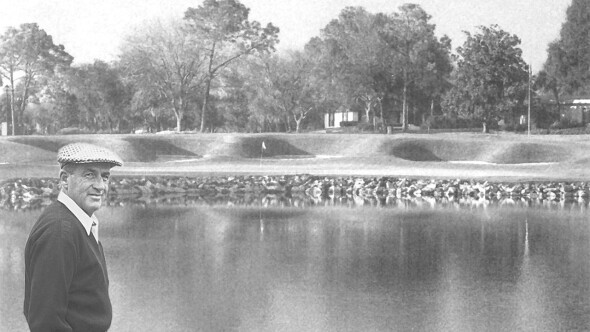
Bay Hill's iconic finishing hole juxtaposes a vanilla tee shot - just hit it straight - with one of the mid-century era's more intriguing green sites: a banana-shaped putting surface wedged into place by three bunkers and one final round pond with jagged rocks waiting to add a sense of grim spectacle to imprecise approaches.


Comments (0)