


 Back
Back






Golf equipment prices keep going up. Not much more than a decade ago, $300 was considered a barrier price for a new driver. Now, the $600 frontier is within sight.
The price of irons has surged noticeably as well. Several years ago, the big OEMs tended to keep the price of a set below $1,000 with rare exceptions. Lately, $1,200 seems to be the new standard, and while this doesn't seem like as big a jump, keep in mind that the definition of a "set" of irons has shrunk in most cases. The old standard 8-club set from 3 iron to pitching wedge is largely a thing of the past as many golfers no longer carry anything longer than a 5 iron. In many cases, full-retail consumers are paying more for fewer clubs.
(On a personal note, I don't find current retail prices for golf clubs to be outrageous because there's a wide variety available, and even though there are golfers at every course who buy all-new clubs every year, there are also many of us who know that there is way more than a year's worth of great shots in any club, especially ones we've been fitted for. I've had my current Titleist irons for a decade and while I like saving money as much as any frugal golfer, I know there would be plenty of value and peace of mind in sticking with them or another of the big names for my next set, too.)
At the same time, there are more ways to avoid paying full retail than ever before. The used golf club market continues to offer tons of options for the budget-conscious, and models from the prior year or two can often be found at attractive discounts through closeouts and bargain-bin sellers.
Then, there's the direct-to-consumer approach, which has started to work for several golf club brands in the way it has for a host of new golf ball brands in the last five years or so. By enabling golfers to buy direct, these entrepreneurial brands are rejecting the traditional way of doing business, where they would concentrate primarily on manufacturing and distributing clubs wholesale to retailers who would then mark them up for sale to golfers.
The challenge for these aspiring disruptor brands comes in distinguishing themselves in the marketplace without the benefit of green-grass golf course accounts and, more recently, the big retailer brands, not to mention the millions of dollars the big OEMs spend on visibility- and validation-providing contracts for elite players.
How can a new golf club brand get golfers to bypass the companies that have for decades effectively harnessed star power as a way to move widgets?
One answer is to beat them on price. Another: deliver a more premium offering with a custom/"bespoke" approach and market it to match.
Direct-to-consumer (DTC) golf club companies, like their ball-making brethren, appear to be here to stay, especially as the coronavirus pandemic has accelerated shifts in consumer behavior toward the online buying experience. Here is a quick overview of your options in this field.
5 value-oriented direct-to-consumer golf club brands
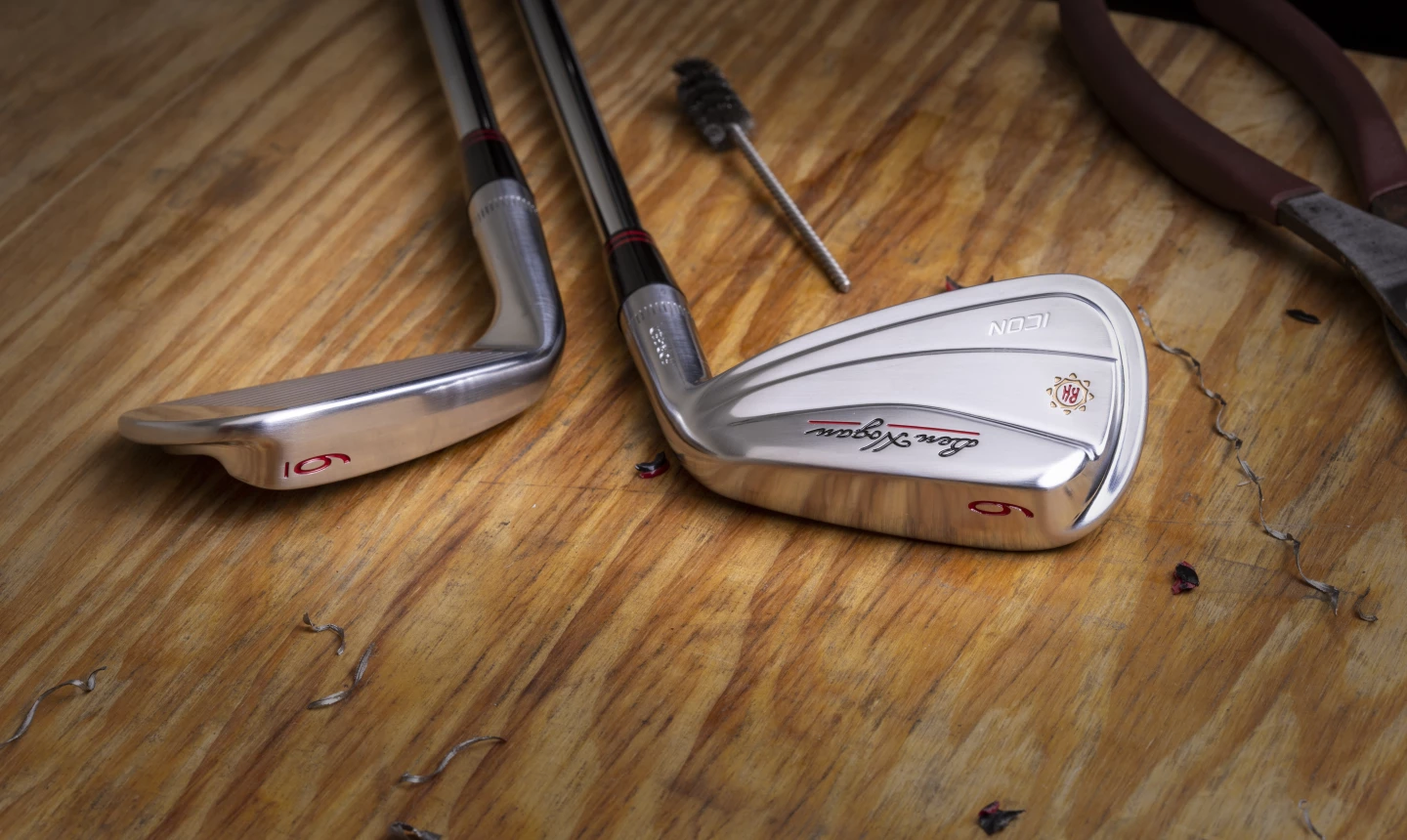
Ben Hogan

Even though he passed away in 1997, Ben Hogan's name still carries mythic weight among students of golf. That was why the clubmaking operation that bore his name did so well in its first iteration from 1953 to the early 2000s.
The more recent iteration got off to a fitful start but has since hit its stride as an early DTC brand. Based in The Hawk's hometown of Ft. Worth, Texas, the "new" Ben Hogan is steadfast in its commitment to a traditional aesthetic, but makes gestures toward modern technology that helps it compete in the current marketplace. A full range of clubs is available, but as before, the irons are the big focus, with purists salivating over the new ICON irons, which come priced at $770 a set in 4 iron through pitching wedge ($800 in a black finish). Higher handicappers have the PTx Pro and Edge models to help them, too, and the Equalizer wedge line has earned plenty of positive reviews.
Sub 70

Sycamore, Ill., population 18,000, is not known for much other than being the site of a rare mild Midwestern earthquake in 2010. But it's the hometown of Jason Hiland and his Sub 70 golf club brand. With strong emphasis on personalized and friendly service along with a sub-$500 price tag for a set of the original game-improvement-oriented 699 model, Hiland has carved out a quick niche for his company. He has been known to respond to customer questions personally and his cell phone number is listed on the company website, adding to Sub 70's mystique.
New Level

Like Sub 70, New Level is the result of one man's strong vision, backed by plenty of knowledge of the equipment game. Founder Eric Burch was an experienced clubfitter who would go on to found and then sell Club Conex, an attachment that enables fitters to seamlessly swap any clubhead onto any shaft in order to dial in a golfer's best options during a fitting. His intention with New Level Golf was initially to function on the more traditional model, with dealers and brick-and-mortar accounts, but the vast majority of his sales have come from his website. Burch's newest offerings include the forged PF-1 and PF-2 irons ($840, 4-PW set), which begin shipping in October.
Haywood

Based in Vancouver, Canada, Haywood has built a loyal following, who appreciate their two iron models (blades for highly-skilled players, a more forgiving game improvement model for everyone else), plus wedges and a putter that, at $200, is about as inexpensive as can be found for a CNC-milled head. Haywood's Signature irons go for about $650 a set.
Robin Golf

Golf club manufacturers seldom market directly to beginning golfers for the same reason fishing in a pond is better than digging a pond and then casting your line. But Robin Golf is a rare direct-to-consumer brand that focuses on new and casual players whose marginalization also makes them an untapped market. Their simple product offerings seem key to the pursuit of this segment of the market. Avid golfers can be overwhelmed by the sheer number of different products available; streamlining things for beginners is a shrewd move, even understanding that not every set will be perfectly matched to its new owner.
Robin's gambit seems to be paying off; they are currently sold out of their base men's and women's (9 clubs, $799) sets, but still have junior sets (6 or 7 clubs, $259-$289) available on their website.
Direct-to-consumer shaft company: Steadfast Golf
Premium aftermarket shafts can cost as much as a new driver, so Steadfast golf seeks to apply the same direct-to-consumer principles to their own offering. The Saint Joseph, Mo.-based operation touts materials quality and manufacturing tolerances as tight or tighter than the big-name competitors, leading them to claim their $99 driver shafts are the straightest in golf.
Premium prices with a direct-to-consumer feel
Not all direct-to-consumer golf companies are driven by the goal of undercutting OEMs' prices while delivering a comparable product. There is also a significant strain in the golf merchandise business that pitches craftsmanship and authenticity at premium prices. This is especially true on the soft goods side (more on that in a future article), but also to an extent in the club market. The medium of choice for establishing most DTC brands these days seems to be Instagram, and golf startups are very active there.
National Custom Works pairs an extremely traditional aesthetic with high craftsmanship. They source Japan-forged irons and wedges which industry veterans Don White and Jeff McCoy then hand-finish to clients' precise pre-determined specifications. NCW may broadly follow the direct-to-consumer model since there's no retail middleman, but this type of bespoke work does not come cheap. Of course, the end result is something closer to art than any other golf club company cares to achieve.


Stay in the Swing with GolfPass!
Get exclusive tips from the pros, in-depth course reviews, the latest gear updates, and more delivered straight to your inbox.


Comments (15)
I am trying to find out some information an the Teton hybrid Driver your thoughts on it and is it available for purchase and where. Thank you Jerry Capra
Hello Golf Advisor Community!
Thanks for the shoutout in this awesome article! There are a lot of great companies on here and we are honored to be included.
We invite you all to come check out our website www.steadfastgolf.com for more info on our carbon fiber golf shafts.
We have a lot of great info and content on our Facebook page as well as daily content posted on our Instagram "steadfastgolf"
Any questions you have, please reach out and we would be happy to help!
Happy Swinging,
Steadfast Golf
James 1:12
I am trying to find out some information an the Teton hybrid Driver your thoughts on it and is it available for purchase and where. Thank you Jerry Capra
Hello Golf Advisor Community!
Thanks for the shoutout in this awesome article! There are a lot of great companies on here and we are honored to be included.
We invite you all to come check out our website www.steadfastgolf.com for more info on our carbon fiber golf shafts.
We have a lot of great info and content on our Facebook page as well as daily content posted on our Instagram "steadfastgolf"
Any questions you have, please reach out and we would be happy to help!
Happy Swinging,
Steadfast Golf
James 1:12
Ich bin gegen covid 19. Was ist deine Meinung? mituns
I have purchased several sets of clubs from Warrior Custome Golf and have found them to have a good shaft and club desiign. I'm surprosed that they weren't mentioned in your article.
No mention of Gigagolf? They have decent irons for $25 each, forged wedges for $50 each, and hybrids for $60 each. I use all three, and my 6-hybrid is my favorite club.
$700-800 per set "direct-to-consumer" pricing is preposterous. I realize that there are thousands of amateurs out there who would regularly pay that - and more - in an effort to try and lower their scores, but the simple truth is that the year-to-year "improvements" in equipment technology are miniscule, so if you're a below-average golfer (or worse), then you'd be better off spending your money with/on someone who understands the game and can help you with your swing and overall game.
Retired Teaching Pro
How much is the iron set for a senior
YOU SHOULD MENTION GOLF WORKS AS WELL, WHERE YOU CAN GET YOUR SET MADE BY THEM USING THEIR COMPONENTS
I saw the Hogan clubs at the PGA Show and was very impressed. There is no reason why you shouldn't try clubs made my direct manufacturers, especially if they offer 100% satisfaction, and their clubs fit your game. I fit for one of the big box stores, and they make 100% profit on used clubs, and upwards of 50% on new...don't let them tell you they have thin profits! THEY DON'T!
Excellent article.
I have played by Tommy Armour Silver Scot 845's for over 16 years now. Have tried new clubs every year but I have a saying....if it is not guaranteed to take a shot off my game, it is not worth the investment just to have what is new. No set of 8 new clubs has ever taken 8 strokes off my game. My 845s are lofted up to 8 degrees higher than a comparable club in new sets ("Our 7-iron goes farther than everyone elses"....yeah, because it is lofted like a 5-iron), but I still, at 57, hit the same "number" or higher than playing partners and usually am longer.
That being said, I became aware of the Hogans as about four years ago I looked at the old Hogan manufacturing building as a real estate investment. Researched them, have "rented" clubs from them using their demo program, and I love them. Not going to save my game, but when it comes time to finally put the 845s in the corner, I am going with the Hogans.
Same with putters. The TM Spyder performs awesome. But so does my Dunlop Vision that I bought at Walmart 20 years ago for $35. Currently average 1.25 putts/hole/round. Yeah, spending $300 on a Spyder is not in my near future.
Traditional manufacturers are just hurting themselves with their price points, IMO.