


 Back
Back






Over the past half-century, Medinah Country Club's No. 3 course has been one of golf's more versatile championship venues. Where other high-profile clubs have tended to become associated with one particular golf institution or championship (e.g. Pinehurst and its USGA "Anchor Site" status), Medinah has emerged as a Swiss-Army site of sorts.
The 2026 Presidents Cup helps to solidify Medinah's intriguing position within American championship golf. As a century-old club, it is a historic place. But in completely reinventing the most famous of its three golf courses in the current decade, it has also looked towards the future with less regard for the past than it might have otherwise cleaved to. By daring to abandon previous generations of design, the club's membership can now take pride in its history while simultaneously claiming one of America's most exciting new championship layouts, with one of professional golf's top match-play tilts as its coming-out party.
Medinah Country Club's No. 3 course and the 2026 Presidents Cup
7,548 yards, par 70
76.8 Rating | 143 Slope
Big shoulders. Located in the city's northwest suburbs, Medinah No. 3 has been a go-to championship host in Chicagoland for decades. It hosted the 1949, 1975 and 1990 U.S. Opens, as well as the 1999 and 2006 PGA Championships - two of Tiger Woods' three Wanamaker Trophy-worthy performances. The 2026 Presidents Cup will make it the second course to to have hosted both major international match-play events in its history, and the first since Muirfield Village added the 2013 Presidents Cup to the 1987 Ryder Cup in its own championship reusme. American golf fans are still sore at seeing the 2012 Ryder Cup slip away at the hands of Team Europe at Medinah.
Aussie invasion. Even if any scar tissue from 2012 lingers in Team USA's psyche across competitions, the Medinah No. 3 that greets them for the 2026 Presidents Cup will be unrecognizable, thanks to a complete overhaul overseen by, of all people, International Team captain Geoff Ogilvy and his OCM Golf Course design team. Like Ogilvy, the 'C' and the 'M' in the firm's masthead - Mike Cocking and Ashley Mead - hail from Australia and are steeped in its great courses, many of them defined by distinctive bunkering and greens with plenty of character.
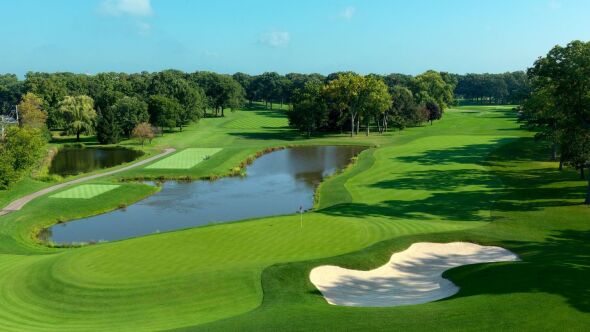
Post-renovation, Medinah No. 3 has a decidedly Australian look, albeit adapted for an American parkland environment. Sand comes in clusters of cape-and-bay shapes, as well as impressively complex single hazards, some of which feature islands of waving long grass. Greens of varying shape and size allow for roving hole locations that will bring subtly different looks and approach considerations from one match to the next. Everything has more room to breathe thanks to the removal of hundreds of trees that had an outsize impact on the way the course played until this decade.
Medinah marks OCM's highest-profile American project to date, although they have found other interesting work as well, from redesign work at historic Shady Oaks in Texas to brand-new designs at highly exclusive clubs like Luling, also in Texas, and The Fall Line in western Georgia. Tepetonka, an OCM original in rural Minnesota, opened in recent weeks. The firm has been associated with upcoming and ongoing work in Canada, Tasmania, Utah and other points in the U.S. Positive reviews of Medinah No. 3 in the wake of the 2026 Presidents Cup should generate even more opportunities for them.

Third (or fourth) design's a charm? Few notable American golf courses have undergone more transformations than Medinah No. 3. The course was originally laid out by Tom Bendelow, early American golf's most prolific architect, and opened in 1928. It held its first professional event two years later, and was awarded the prestigious Western Open in 1939. But that has not stopped club brass from tinkering with the course several times throughout its history. In 1986, the club conscripted prolific Midwest architect Roger Packard for a significant redesign ahead of the 1990 U.S. Open. Less than 20 years later, the club brought in Rees Jones to update the course ahead of the 2006 PGA, and Jones oversaw further adjustments for the 2012 Ryder Cup.
The OCM work is by far the most significant change the course has seen in decades, and represents a departure from the midcentury-modern mode of demanding but relatively straightforward shot values to a more dynamic mode. One of the key changes OCM made can be seen on and around Lake Kadijah, which runs through the property and separates No. 3 into two sections. In the past, three of the course's four par 3s played straight across the lake. OCM focused considerable attention on this body of water, making sure it could be tackled from different angles, rather than being used as a blunt-force hazard. Two of No. 3s par 3s still do cross it, but there is more variety in the orientation of their greens, and while a third par 3's green sits lakeside, the tee angle runs along the shore. On the par-4 12th (normally the 16th in the members' routing), Tee shots will be played diagonally across the lake, adding a new wrinkle to golfers' interactions with Medinah's dominant internal feature.


Comments (0)