


 Back
Back






MT. ENTERPRISE, TEXAS - You see it on hats, t-shirts and airport-sold fridge magnets galore.
"Don't Mess With Texas."
As very much a non-Texan, I have always read that four-word phrase as a warning to outsiders like me, with "Or Else" as a silent kicker. We do things our own way here, and we don't need your input. By the way, we keep our shotgun loaded. Just in case.
But maybe that's a harsh reading. Maybe "Don't Mess With Texas" is also a gentler admonition or even some sort of prayer to preserve, protect and accentuate the state's vast and diverse stores of resources and beauty, with "Please" implied on the front end.
In that pleasanter case, it would seem that Texas is an ideal place to bring the philosophies of golf course developer Michael Keiser and architect Tom Doak to bear.
After all, "Don't mess with..." has been a guiding principle for the Keiser family, starting with patriarch Mike, who pioneered the contemporary golf resort model at Bandon Dunes and whose sons Michael and Chris have spread and deepened its influence across the United States and the wider world at a time when golf has enjoyed renewed popularity and cultural cachet. They have worked with a cohort of 21st-century golf architects whose own north star is to lean into the land, rather than seek to dominate or excessively manipulate it. The result is a growing list of nouveau-golf-resort outposts unified by rolling, sandy sites on which Doak, Bill Coore & Ben Crenshaw and others have built intriguing golf courses that are attractive to a savvy clientele of occasional visitors as well as prospective members and homeowners.
At Wild Spring Dunes, a 2,400-acre tract set deep in east Texas' portion of the American "Piney Woods," Doak and some of his longest-tenured associates collaborated on a strong tone-setter of a first golf course (initial green fee: $275).
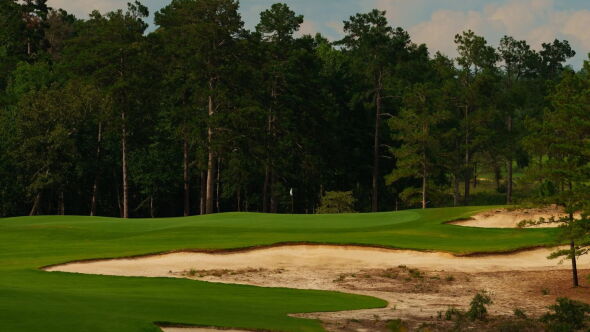
As at Sand Valley in Wisconsin and at Rodeo Dunes in Colorado, Wild Spring Dunes' first tee sits atop a modest hill, giving the golfer a generous first impression of the course's environment. In this case, the palette is stately pines that preside over sparse scrubland that includes yucca and even small cacti at times. Golf balls that wander off the fairways are often findable and hittable, but advancing a recovery shot more than 100 yards is somewhat left up to chance. Best to stay in the generous fairways, whose exquisite zoysia turf, minded by superintendent Chad Kuzawa and his team, props the ball up beautifully.

The course's overall scale is reminiscent of England's great heathland golf courses, just with a different assortment of vegetation. Among recent Doak courses, golfers who have played Pinehurst No. 10 will find Wild Spring Dunes a close cousin. At other times, one is reminded of Doak's excellent renovation work at Houston's Memorial Park. Tucked away miles from the nearest town of any size, the course's secluded setting makes it an almost overwhelmingly quiet place to play on a still day. It is a rare pleasure to hear one's approach shot land on a green more than 100 yards distant.
Wild Spring Dunes' routing unfolds in two counterclockwise lobes, with the first eight holes rambling over gentler hills and the par-4 ninth re-launching golfers off the starting hilltop into more heaving land and along deeper ravines before a mellow finish. Doak's routing prowess is in evidence here, giving golfers a good initial taste of the property before revealing its full flavor in Act II. Along the way, he and his associates fashioned a typically engaging and varied set of 18 holes that rest confidently on the terrain. Gently scraped-out bunkers create strategic pinch points in the otherwise generous fairways and complicate attacks on the putting surfaces. The best of them have irregular shapes and transition seamlessly into the surrounding scrublands.
Overall, Wild Spring Dunes' greens exhibit a measure more subtlety of contour than some of Doak's more eccentric sets, though there are still moments where being on the wrong level or side of a hole location can be appropriately treacherous. An innocuous-looking central hole location on the par-3 third hole proved tricky as it sloughed a couple of decent-but-not-good-enough tee shots into a lower-right hollow. Even just after opening, the course's putting surfaces are exquisitely smooth, delightfully firm and plenty fast for the amount of contour they do possess.

The most intriguing holes at Wild Spring Dunes sit at the margins of their par figures. The 10th is a masterpiece of a long par 3, stretching past 240 yards from the tips. It comes at the perfect time to snare a golfer who has just played a solid front nine and feels confident in taking the direct line to a large green perched above bunkers and a ravine. The menace of this hazard is juxtaposed with a fair few acres of gentle bailout fairway short and to the right. Long one-shot holes are often either too strenuous or too indifferent. This one shoots the gap perfectly, especially in match play, where the tactics of the first and second golfers to hit may vary wildly.
On the other side of the same ravine, traveling in the opposite direction, sits another excellent shorter hole: the 331-yard par-4 17th. It too offers plenty of room to the right for conservative tee shots, but this time, every extra degree of bailout sentences the golfer to an increasingly awkward wedge approach across the pitch of a skinny, two-level green corseted by bunkers. The thinking golfer can create a significant edge over one with raw talent here.

As the second Michael Keiser-led golf resort and community project to begin welcoming golfers in 2026, the golf course at Wild Spring Dunes invites some comparison to Rodeo Dunes and its initial Bill Coore & Ben Crenshaw design that sits an hour east of Denver and which I visited in May. Rodeo Dunes' wide-open chop-hills setting, with the Front Range and Denver itself visible in the distance, embodies the American West in a wholly immersive way, with the golf course features themselves following along with panache.
Wild Spring Dunes' setting is lovely, too, but also feels somewhat less geographically specific, admittedly through no real fault of its own. At times the golfer feels like he could be in North Carolina or Wisconsin. And while the holes themselves are composed with great competence and sensitivity, the whole of Wild Spring Dunes does not quite exceed the sum of its parts as much as its Colorado cousin does. Could Doak & Co. have gotten away with messing with Texas a little more than they did? Nevertheless, in time, Wild Spring Dunes seems destined to claim a place as one of the top 30 to 50 American public golf courses. As the resort builds out, it should bring a steady stream of eager travelers to discover the Piney Woods' possibilities for golf.





Comments (0)