


 Back
Back





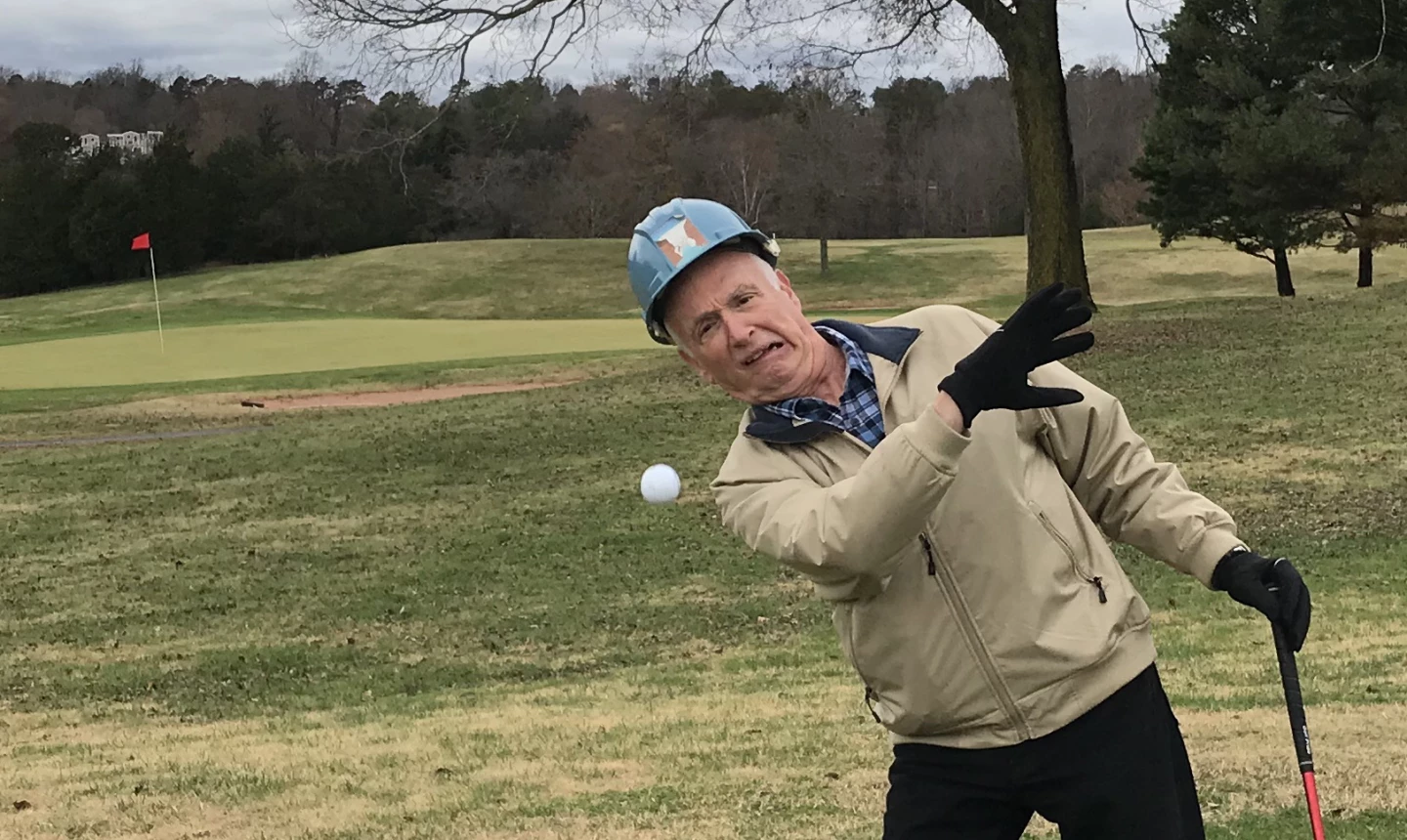
Can you imagine wearing a helmet to play golf? That could be in your future, according to Protecting.co.uk, a British-based company that provides heath and safety advice and legal consultation. The company recently made waves when it reported that a number of insurance companies were looking for ways to ease liability and reduce the financial burden stemming from golf course injuries. Wearing a hard hat to protect against wayward golf balls grabbed the headlines. The story noted that other popular sports, from rugby to cycling, have taken measures to reduce injuries by requiring headgear or helmets. The story went on to say that golf is statistically a greater risk to participants than rugby, and that 16 to 41 percent of amateur golfers (presumably depending on the study, though none were cited) suffer some sort of golf-related injury each year.
While I find the statistics quite surprising and want to stress that the company’s posting is vague and doesn’t specify the types of injuries that befall golfers, it certainly is true that being hit by a golf ball while on the course is a very serious and common occurrence as well as a potentially life-threatening event. I even wonder if the timing of this helmet-wearing story could in part be a reaction to the horrible injury suffered by the Ryder Cup spectator who was struck in the eye by a tee shot hit by Brooks Koepka (and later announced plans to file a lawsuit).
Protecting.co.uk's Chris Hall told us that if insurance companies start demanding golf facilities take steps to improve safety, you could start seeing hard hats on golf courses. I’m sure being told they must wear a helmet when teeing it up is one of the last things players want to hear. It also begs the question of how helpful helmets would be in preventing injuries. Though it can be argued that this rather sensational story will ultimately do more to boost Protecting.co.uk’s profile than bring about serious safety reform, there’s been no shortage of coverage of the golf helmet proposal.
How scared are you about being hit when you play? No doubt your concerns are not simply related to who might be on the course hitting shots. Certain characteristics of golf facilities and features of golf course architecture lead to greater risk. Here are a few that might have you wishing you were wearing a helmet:
Adjacent fairways
I’ll wager almost everyone who has played the game can recall having to wait or get out of the way when a player from another group finds your fairway rather than his or her own. Whether it’s a muni or a notable layout, an all-too-common design formula on tight courses is to lay out fairways side by side to gain some extra width. Most recently, during a round at Monarch Beach Golf Links in Dana Point, Calif., our group had to move aside several times as players on other holes entered our fairway to hit their recovery shots.
Set-back tee boxes
Normally, when leaving a green, you move forward to get to the next tee. Sometimes, especially on vintage golf courses or retro-styled minimalistic layouts, the next tee may be right beside a green. A full-on shank or pull could create a hazardous situation, but there’s even more danger if the tee boxes extend back to an area that’s actually somewhat behind the green. This has become quite common as courses add length or an extra set of tee markers to better defend par in the age of modern equipment.
Blind holes
Hopefully the players in the group behind you will wait sufficiently before teeing off on blind holes. It’s always nice when there’s a bell to provide the all-clear sign. Without the reassuring fairway bells on the Sagamore Golf Club in New York’s Adirondack Mountains, I would have spent many an anxious moment on the fairways of that Donald Ross gem.
Double greens
When two holes share the same green, there are two flagsticks and two holes. In most instances, the putting surface is extra large and the targets are quite a distance from each other. But all-too-often I’ve hit approaches that have wound up closer to the other pin than the one I was aiming for. Also, bear in mind that entire groups congregate on a green, so the possibility of hitting someone increases several-fold. And if you think a double green is hazardous, how about a triple green? Yes, nerves can fray over incoming shots on the The Reserve Vineyards & Golf Club - North Course in Portland, Oregon, where the 1st, 17th and 8th holes all share the same putting surface.
Holes near driving ranges
Oftentimes, facilities put up a large net to protect players. Sometimes they don’t. I couldn’t tell you how many times I’ve found myself looking for my own mishit ball amidst the balls on a range. It’s one of the times when you know you’re at risk, but you try to rush to your ball and whack it back into play before any harm comes to you. Earlier this month I successfully dodged shots while hitting my ball from the edge of the range at the Fazio Course at PGA National Resort & Spa.
Crossover holes
There’s always a moment of trepidation when the routing calls for shots from one hole to be played across another hole. This may be a design feature employed to take advantage of a propitious landform, such as a tee box perched on a ridgeline, or it may simply have been the only way to coax enough viable tests into a full 18-hole playing field. At Tom Doak’s glorious Tara Iti Golf Club in New Zealand, play is sparse enough so you really don’t have to worry about getting caught in a shooting gallery. The concern is front and center on the Klondyke hole at Lahinch, which crosses the 18th fairway. A sign at the top-rate Irish links warns players that they must ensure no one is in jeopardy when playing over Klondyke.

Reachable par fives
Normal protocol says that players wait until the green clears, but inevitably someone always gets impatient and goes for it. The same could be said on short par 4s, but generally it's likelier a ball will be coming in hotter or higher on a shorter par 5 than a drivable par four.
Any tee box
I have to admit this one can be the scariest of all. You’re standing off to the side of the tee box at a reasonable distance as your playing partner smashes a drive. Without any warning whatsoever, the club head flies off when he makes contact with the ball and goes whizzing by. Luckily, it lands without hitting anyone, but for the Grace of God, it could have gone anywhere and been a disaster.
Knock on wood, I’ve never hit anyone on a golf course or been hit by a stray ball or a club head. Have you? Is the course where you play hazardous to your health? If so, what layout/design characteristics make it dangerous? And would wearing a helmet provide you with any degree of extra reassurance? What would it take to get you to wear protective headgear on a golf course?


Comments (47)
what, if there yould be golf caps like your one which have a shockabsorbating technique included? i would wear that - but no hard helmet… would you?
continued from previous comment.
High level golf is generally safe due to skill factor and players/caddies are also mindful to call when a ball is misdirected. On the subject of spectators; watching pro golf and seeing the sides of fairways lined with spectators, there is often a scenario when a clear and loud call of fore is made with little reaction from spectators. As a player and on hearing a warning, you instinctively anticipate its direction. I have trained myself to turn/spin away and drop my head down. Better to be hit on the back or fat arse than on the face, or even the jatz crackers. Some player/spectator education in this practice may save some from serious injury. Cheers and happy and safe golfing from Greg in Townsville
what, if there yould be golf caps like your one which have a shockabsorbating technique included? i would wear that - but no hard helmet… would you?
continued from previous comment.
High level golf is generally safe due to skill factor and players/caddies are also mindful to call when a ball is misdirected. On the subject of spectators; watching pro golf and seeing the sides of fairways lined with spectators, there is often a scenario when a clear and loud call of fore is made with little reaction from spectators. As a player and on hearing a warning, you instinctively anticipate its direction. I have trained myself to turn/spin away and drop my head down. Better to be hit on the back or fat arse than on the face, or even the jatz crackers. Some player/spectator education in this practice may save some from serious injury. Cheers and happy and safe golfing from Greg in Townsville
I play golf in northern australia. I wear prescription glasses but even if these were not required, I would still wear sun glasses. There are many styles of hats that provide some protection for the temple area. It is the golfers choice and if it his/her appearance / or ego ( desire to look like Tiger or other favourite pro ) is key then so be it. His/her call and associated risk.
I would "think" that the helmet recommendation would pertain to spectators before it would golfers themselves. I would probably not play if I had to wear a f'n helmet.
This whole premise does not make sense. Exactly who would require the helmets? The USGA? How would it be enforced? The same way they make sure you use a legal ball, have the right number of clubs and your driver is not over specs? Personal insurance? They do not have any requirements for sports equipment as it is now....do not require kids to wear bike helmets, do not require kids to use certain types of football helmets, they just do not get into that stuff. The club? If they did, they would go under. Besides, they are not liable if you get hit by a ball. I am willing to bet the stats are misleading anyway. Yeah, golf may have more reported injuries than rugby, but I would venture to say golfers outnumber rugby players by a good 100:1 if not more. And these injuries? Those are rarely due to getting hit by a ball. Those are swing injuries to backs, wrists, elbows, knees, etc. Injuries due to balls and clubs cannot possibly account for any more than 1% of all that are reported.
This is about the stupidest thing I've ever seen.
A ludicrous suggestion that is purely for the benefit of insurance companies. I've been golfing for more than 60 years, I've never been hit by an errant golf ball and can only vaguely recall the only instance I've heard of. I have, though, occasionally been forced to shelter from lightening, which is far more dangerous than being hit by a golf ball. More than a few golfers have been killed by lightening, often when holding an umbrella in a rain storm, an implement which attracts lightening. Rather as a helmet would, I imagine. Plainly the insurance people know nothing of this, as they appear to know nothing of golf...
What a stupid suggestion - wearing a hard hat will not be of much use - I have played golf for 58 years & have never heard of anyone being hit "on top of" their head !
Even the most recent one was a lady that was hit on the eye... interestingly when others around her ducked - she didn't move, presumably thought she was immune.
How silly.........I agree with the person who says it might sound a bit like an insurance scam.
I was hit on the back this year from a drive shot, which may have hit me on the head if the player who took the shot had not called out "fore".
This all seems to me to be another 'money scam'
I have been playing golf for more than 30 years and have been hit twice , on my head , but fortunately escaped serious injury. On one occasion, it was because of my own fault rushing ahead of my other flight mate and got hit by him because he badly shanked the ball and came to a place where I did not accept him to come. On the second occasion, it was a wayward ball from the opposite side from a parallel fairway when I got hit by the ball after it hit a tree.
While I believe that making the golfers wear a helmet will negate all the fun of playing golf, I do believe that :
(i) safety of players must be a basic feature of golf course design and no golf course should be licensed to operate unless it is certified by relevant authorities safe for players and the spectators;
(ii) when public is being permitted to watch tournaments , it should be the responsibility of the organizers to ensure that the spectators are kept out of the harms way . Many times it is seen during the international tournaments that the spectators are almost on the flight path of the players , which is bad for the players as well as the spectators.
In short , I am against the suggestion of making the players wear helmets , but recommend better course design and better control of spectators during the tournaments.
Devinder Singh