


 Back
Back






ROGGEN, Colo. - "What's over there?"
It's the question that has spurred virtually all of human exploration. The opportunity to gaze over an expanse of land and wonder what it's like where the farthest ridge or tree line conceals everything from view has pulled Man to all ends of the planet and beyond.
What's over there? has been the question that has birthed many compelling golf courses along the way. It is the question that led Michael Keiser, Jr. off Interstate 76 and out of his car to trespass onto private ranch land about 50 miles east of Denver, nearly landing him in big trouble with the ranch's owners, the Cervi family. But it led Keiser, the Cervis and eventually architects Bill Coore & Ben Crenshaw and their team of shapers and builders to produce Rodeo Dunes, the first 18 holes of the American West's next golf playground.
The drive from central Denver east to Rodeo Dunes is disorienting in the best way. I left my hotel in the city's chic Cherry Creek neighborhood just after dawn and just over an hour later, I was standing on don't-blink-or-you'll-miss-it main-street Roggen, Colorado, population 574, looking up at a farm elevator with PURINA CHOWS printed on it. The unmistakable smell of dog food hung in the air. I looked back west and, it being an almost cloudless spring morning, I could still see the snow-topped Rocky Mountains some 80 miles distant.
What an introduction.

Thankfully, a few miles across Interstate 76 and down a dirt road, Rodeo Dunes smelled and looked not like puppy-chow but like a brand-new golf course that golfers will flock to play. The sandy landscape it rambles is known as the "chop hills" - useless to the Cervi family as farmland but the sort of topography that golf course architects salivate over and golf course developers trespass upon. It is a landscape reminiscent of the one where in the 1990s, Coore & Crenshaw helped shift the paradigm of modern golf design with their minimalistic, rugged Sand Hills Golf Club in remote central Nebraska, which helped launch them to wide acclaim and helped redirect the philosophy behind golf course architecture away from a modern mode that valued heavy earth-moving and ostentation.
Traversing Rodeo Dunes' routing is like imagining Keiser's or Coore's initial wanderings across the site. Many holes flow logically but there is also a pleasant occasional arbitrariness to it, where the next tee area is hiding just around the next dune. Interior shortcuts within the greater loop sometimes reveal themselves; one could hop from the second green to the 16th tee for a five-hole twilight emergency loop, for example. Occasional junctions where multiple greens and tee areas converge give groups the feeling that they are among friends in a location otherwise seemingly devoid of human life. As vast as it is, it is a startlingly quiet place. Looking across the course often reveals heads of golfers and caddies popping out from between faraway dunes. Despite its various direction changes and sorties, Rodeo Dunes' routing itself is contiguous, devoid of any crossovers, with the 18th green adjacent to the first tee. It is a rewarding journey.

Coore & Crenshaw, as well as lead associate John Hawker, clearly had fun using their raw, rugged material to create exciting golf that bucks but does not brutalize. Rodeo Dunes is an 18-hole game of hide-and-seek; many landing areas are partially or totally obscured from tees, and seldom with the golfer see the entirety of a putting surface from even a good spot in the fairway. Caddies more than earn their keep here, acting not just as sherpas but sentries without whom their golfers might occasionally take accidental friendly fire from groups behind. There are one or two places where a warning bell might be a good idea. Off-fairway areas are surprisingly playable, with some exciting recovery possibilities instead of long-grass lost-ball-city everywhere.
Rodeo Dunes is not afraid to get a little rowdy with bunkering and greens. In anticipation of reliably firm, fast conditions once the course fully matures, there are some particularly thorny spots behind greens - trench bunkers and sunken grassy pits of despair. Getting the ball to stop in time will be a fun challenge on greens that may come to be regarded as some of their architects' most adventurous. The putting surfaces on two short par 4s - number 6 and 17 - are especially daring, with some features that will cause frustration for golfers who play clumsily.
One unusual feature of Rodeo Dunes is a handful of long-rough patches in places where fairways drop down a particularly steep dune ridge. There are times when driving the ball a yard too far might leave a golfer with a barely-playable shot from a downhill or sidehill lie after expecting to have found a fairway. Golf may not be much like rodeo, but handling turbulence is a virtue in both.
Coore & Crenshaw are masters at taking what the land gives them, and one particular gift on Rodeo Dunes' inward nine is a pair of consecutive par 3s at holes 13 and 14. The former plays long and uphill to an epic set-piece greensite that drops off a high dune, leaving miles-long views to the right. The next hole, some 70 yards shorter on the scorecard, glides downhill to a green that tilts from front to back and offers little relief except for a high bank on the right that can temper an approach shot. Back-to-back one-shot holes might seem odd in a vacuum, but Coore & Crenshaw manage to make the double-feature effortless.
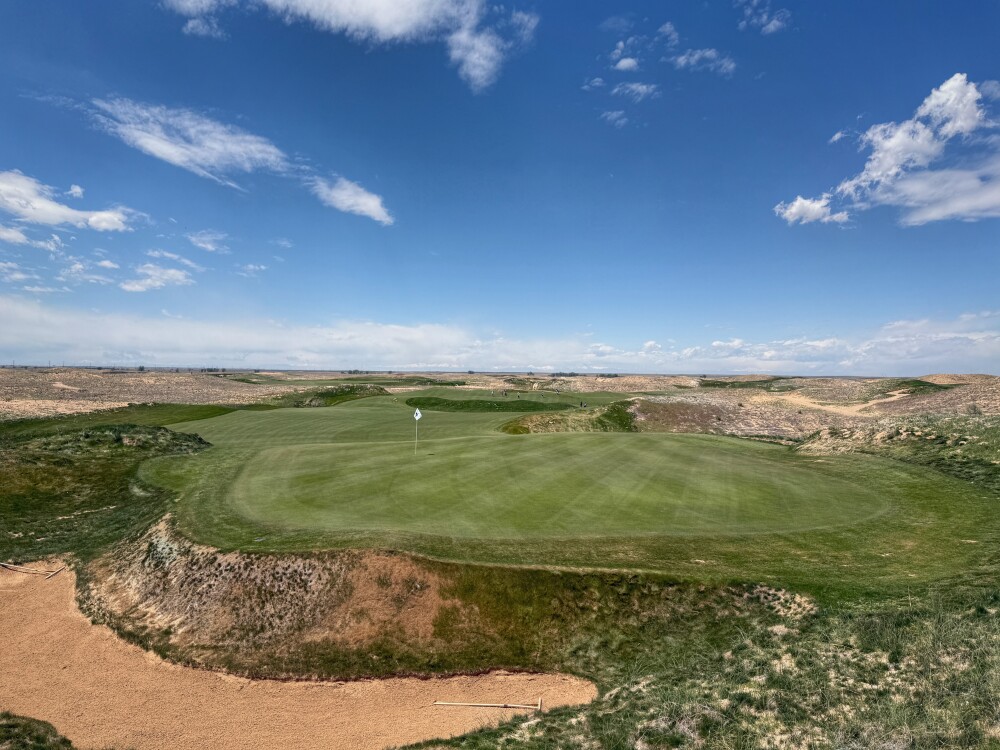

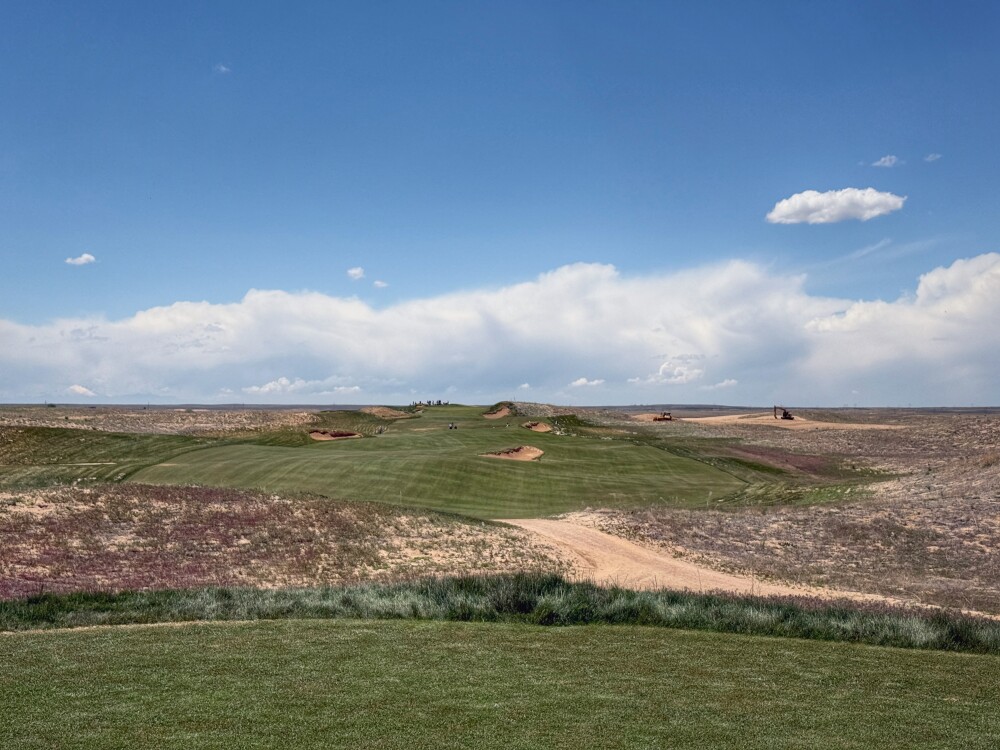
Rodeo Dunes is the first of as many as half a dozen potential golf courses to be built on the 4,000-acre site in the coming years. Fresh off his first solo design work at Sand Valley's mischievous Commons course in Wisconsin, longtime C&C associate Jim Craig is already shaping Rodeo Dunes' second 18-hole course, which will start at the same tee complex as the O.G. Just down the hill, a wild 8-acre putting course - the world's largest until some other developer decides to go even bigger - is also taking shape. Lodging and formal F&B facilities are also in the works.
Rodeo Dunes will be a publicly accessible resort in a similar mold to that of Sand Valley, but its new golf course will belong to a group of 300 founding members throughout 2026 before public tee times are available from May 1, 2027. Golfers will need to sign up at RodeoDunes.com to be notified when 2027 bookings become available this summer.



Comments (1)
No carts! Finaly a place I can play by horseback, sign me up.
No carts! Finaly a place I can play by horseback, sign me up.