


 Back
Back






BLUFFTON, S.C. - Golf courses have been getting bigger lately. Architects and developers gravitate towards sprawling, sandy sites that demand dramatic, sweeping golf holes with large features and bold, ambitious greens. The results are often rewarding, albeit very intense.
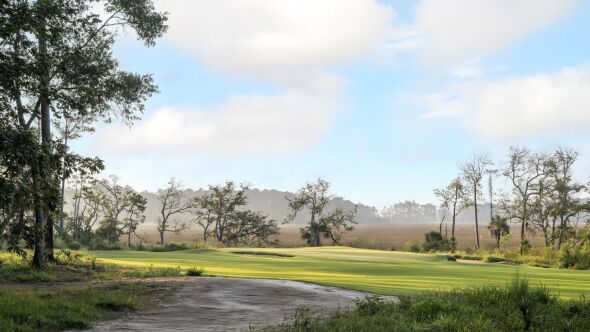
Counterpoint: Anson Point, a new Bill Coore & Ben Crenshaw golf course secreted away within the 20,000-acre Palmetto Bluff property in coastal South Carolina. Where most other new golf courses shout, it whispers, but it has plenty to say.
Anson Point’s quiet location about 20 winding miles upriver (the May River, in this case) from Hilton Head places it in the heart of the Lowcountry, one of America’s most charming regional landscapes. The latest in a long line of stellar Coore & Crenshaw layouts takes advantage of a 500-acre site of gently rising and falling terrain that meanders from deep pine and live oak forests to expansive salt marshes. The routing is masterful, with each nine-hole loop featuring a charming crossover kink as it ushers golfers from inland pine forest to oak hammocks to marsh. Coore & Crenshaw could easily have chosen to route the course in concentric loops so that each group could feel isolated while playing each hole. By eschewing that expansive exclusiveness in favor of something more sociable, Anson Point enjoys a feeling of coziness that feels like a true throwback to early 20th century design. There are echoes of some of England’s great heathland courses like those found at Sunningdale and St. George’s Hill, albeit in a distinctly Lowcountry setting.
A similar grace accompanies Anson Point’s individual holes, which occupy comfortable but by no means bloated corridors. Trees affect several shots throughout the round, as players often need to favor particular halves of fairways to set up unencumbered approaches. Pete Dye was Coore’s mentor in golf course architecture, and the late master’s use of angles is echoed at Anson Point’s best moments. The tee shot on the fiddly par-4 8th is a highlight, as one of the aforementioned trees overhangs enough of the right side of the fairway that the left third of the landing area becomes the racing line. Bailing right means having to shape an approach hard from left to right to a green fronted by a knuckle of close-cropped turf.

This motif returns three holes later on the course’s longest par 4: merely finding the short grass is not enough. And two holes later, on a much shorter par 4, oaks overhang both sides of the sliding fairway in a way that distinctly reminds of Harbour Town, Dye’s masterpiece not too far away. On this sub-360-yard par 4, a golfer can plausibly hit anything from a long iron to a driver depending on the day’s hole location and his or her own preferred shot shape. Anson Point being a members’ course (guests of Palmetto Bluff’s Montage-flagged hotel may only arrange tee times at May River Golf Club and the inventive Crossroads reversible 9-holer), design features like this help make it the type of place one is eager to play repeatedly.
Though Coore & Crenshaw’s names belong on the course’s masthead, a great deal of the execution of the on-course features was overseen by longtime associate Ryan Farrow. The bunkering is splendid, perfectly tuned to the surroundings. The edging of the hazards is pleasantly unfussy, with the more eye-catching flourishes reserved for set-piece moments like the tiny par-3 9th, whose small green wants to shrug any imperfect wedge shot into some sandy hell or another. Farrow is the lead associate on Coore & Crenshaw’s ongoing Pinehurst No. 11 project as well; stay tuned for the opportunity to see more of his handiwork in the coming years.
Anson Point’s private nature may soften its influence in wider contemporary golf design, but its more intimate confines may come to represent something of a reaction to the surging width of many of the 2020s’ most famous courses. Feeling dwarfed by expansive terrain is fun, no doubt, but as an everyday golf course goes, moderation can still be marvelous.




Comments (0)