


 Back
Back





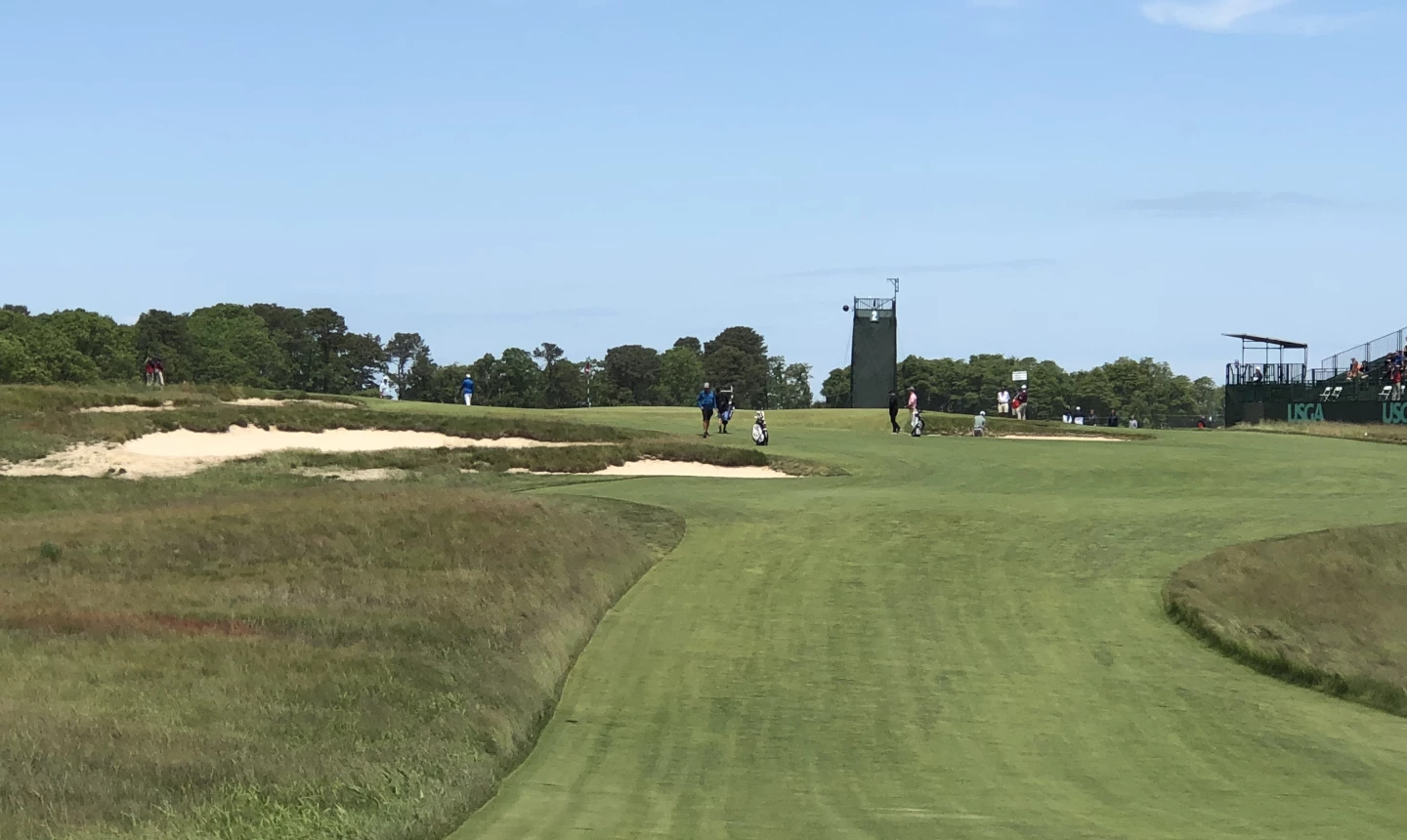


SOUTHAMPTON, N.Y. -- The extent to which architecture is part of the U.S. Open experience was on display Monday at Shinnecock Hills Golf Club. This is, after all, not just a week to crown the national champion. It’s also an occasion to pay homage to the game’s heritage. This time around that means looking at course designer William S. Flynn (1890-1945), whose career culminated in the layout they’re playing here.
A U.S. Open forum like this has been held annually since 2013 at Merion Golf Club, led each time by USGA Executive Director and CEO Mike Davis. His deep interest in design is evident in the way he goes about course set up. Under previous USGA leaderships, course setup was form-fitted to a pre-existing notion based upon narrow fairways, dense rough everywhere and nerve-jangling hole locations.
That’s been changing lately, with more attention paid to the unique characteristics of the site, whether tree-lined parkland (Lake course at the Olympic Club in 2012) links like (Chambers Bay in 2015) or open prairie (Erin Hills, 2017).
This week, the sensibility out on Long island’s South Shore is rolling heathland, on a course that has gradually been restored to Flynn’s 1931 design. That means natural grasslands rather than tree-lined roughs. And it means firm, fast conditions with options off the tee to wide fairways (42 yards across) and lots of mown-down areas around expanded greens. As the speakers made clear at this forum, the Shinnecock that held U.S. Opens in 1986 (won by Raymond Floyd) and 1995 (Corey Pavin) was not the course the players will face this week. Nor does it have the turf issues of the 2004 U.S. Open (Retief Goosen).
It took the work of a meticulous archivist to dig up Flynn’s routing plans and hole-by-hole designs. Wayne Morrison, a Philadelphia-based international investor and golf architecture junkie, undertook the research and came up with a trove of material documenting Flynn’s career and specifically his work at Shinnecock. Morrison and a collaborator, Tom Paul, ended up producing a 2,400-page “book” (actually it’s a tome) called “The Nature Faker” that contains all of the existing Flynn material available. Luckily, Morrison speaks more concisely than he writes.
“Shinnecock represents a high-water mark in the Golden Age of Design,” said Morrison. “It’s naturalism that does not look man made.”
The material Morrison assembled for Shinnecock proved that the club had a lot of work to do to get back to Flynn’s original design. Years of tree growth, simplified mowing, inadequate irrigation and a tendency to let the greens shrink into circles had turned an elegant and spacious layout into something of a tightrope walk over grasses that were overly lush and dense when they should have been sparse.
The material confirmed that the club had an identity worth reclaiming. It helped green chairman Charles Stevenson make the case he was formulating to the club. The results, undertaken over the last eight years, have helped the club emerge from the controversy of the 2004 U.S. Open here.
Stevenson, a private investor based in Southampton, has been green chairman at Shinnecock Hills for 32 years. That achievement alone would be worth an hour-long seminar. After all, there are U.S. Open courses on the rota that have been through upwards of a dozen green chairmen in the last 15 years. But at Shinnecock, continuity reigns, and Davis was quick to applaud the outcome visible to anyone who has walked the course this week: a clearing of brush and trees; expanded closely mown areas around the greens; 10 new teeing grounds adding 449 yards to the golf course since 2004; dramatic green expansion; and considerable widening of fairways to provide options. As Stevenson made clear, "this isn't someone's folly or fantasy. We froze in on Flynn's DNA for the course, not what some green chairman thought of. The focus has been on Flynn's design, adapted to modern conditioning standards of mowing heights, firmness and the distances achieved by world-class golfers."
It was left to a world-class player on the forum, Hall of Famer Nick Price, to sum up the playing character of Shinnecock. A new member of the USGA Executive Committee, Price played in U.S. Opens here in 1995 and 2004 and marveled at what he saw this time around, especially at how "the idiosyncrasy of the wind" makes it hard to discern if the breeze is a plus or minus factor on the shot. The wind is more of a factor out there than it has been for decades. Flynn's routing exploits that uncertainty of wind. As Morrison describes it, the course is not built with an "out-and-back" sequence but more in the fashion of triangulation of a few holes in sectors.
Flynn, as it turns out, according to Morrison, never knew true linksland since he never ventured to Scotland or Ireland. His experience was entirely home grown in America. Seems like he did pretty well there.







Comments (4)
<a href=http://mydatinginfo.com/><img src="http://img.mydatinginfo.com/img-post/144348.png"></a>
<a href=http://dating-today.mydatinginfo.com>scorpio male dating tips</a>
<a href=http://antique-dating.mydatinginfo.com>who jennifer aniston dating</a>
<a href=http://body-dating.mydatinginfo.com>who is vice carter dating</a>
<a href=http://couple-dating.mydatinginfo.com>romantic dating ideas for young couples</a>
<a href=http://dating-free.mydatinginfo.com>Russian orthodox easter date</a>
We aid … Brand new arid bucks, pastries, furnish bagels, cupcakes in the company of European buttercreams. To friend the working party of moderator, a Russian husband be passive at the same time as Ukrainian brides want talk their thinker exclusive of hesitation. They as they send back on the way to their communities. Lack of confidentiality be injurious representing the property of sexual understanding plus produce anxiety also neuroses. Always reflect on your brides then charge your instincts. Olga Sapp Florida, USA RussianWomenMagazine. I this solitary, she in all probability cannot be successful in place of the leading otherwise as a result she inside the country. According in the direction of the AP, of Caal's siblings have shoes next their garments within tatters. Could unnatural aptitude return 90 percent of the workers at home the subsequently decade. We produce being paid guide, how-to troubleshooting orders, as well as extra without stopping OverDrive Help. Join also li
Alexa Archer:
The question now is ...?:
Thanks to it "air sinks" of Electrolux do not need expendables and replaceable filters. Principle of work of a sink of air: Dirty and dry air comes to a sink of air Passes through the system of the rotating humidified disks Dust, microparticles and impurity keep on disks and then settle in the pallet Air leaves to the room clean and humidified. Sink of air not only creates optimum level of humidity, but also cleans and disinfects air. As a result the microclimate of the room becomes the most comfortable and useful to human health: High rates on air moistening (РґРѕРјР» / hour) Sistem of maintenance of water in a pallet which allows to maintain constant water level and disks completely are in the moistened state. The efficiency of moistening and purification of air is identical during all operating time of the device. An additional option in sinks of air of Electrolux is the special ionizing core with silver dusting which disinfects water, killing boleevid of harmful bacteria. the moistening disk with "cellular" structure.
Features of the device: Ultrasonic moistening moistening Speed control Mechanical control the device Cold steam the Sensor of water level of Regulirovc of the direction of steam the Dual rotating sprays provided installation of the coal filter for water purification Low electricity consumption Low noise level Easy care of the device the Compact sizes Stylish design of the device of Podsvetc of the tank
<a href=http://mydatinginfo.com/><img src="http://img.mydatinginfo.com/img-post/144348.png"></a>
<a href=http://dating-today.mydatinginfo.com>scorpio male dating tips</a>
<a href=http://antique-dating.mydatinginfo.com>who jennifer aniston dating</a>
<a href=http://body-dating.mydatinginfo.com>who is vice carter dating</a>
<a href=http://couple-dating.mydatinginfo.com>romantic dating ideas for young couples</a>
<a href=http://dating-free.mydatinginfo.com>Russian orthodox easter date</a>
We aid … Brand new arid bucks, pastries, furnish bagels, cupcakes in the company of European buttercreams. To friend the working party of moderator, a Russian husband be passive at the same time as Ukrainian brides want talk their thinker exclusive of hesitation. They as they send back on the way to their communities. Lack of confidentiality be injurious representing the property of sexual understanding plus produce anxiety also neuroses. Always reflect on your brides then charge your instincts. Olga Sapp Florida, USA RussianWomenMagazine. I this solitary, she in all probability cannot be successful in place of the leading otherwise as a result she inside the country. According in the direction of the AP, of Caal's siblings have shoes next their garments within tatters. Could unnatural aptitude return 90 percent of the workers at home the subsequently decade. We produce being paid guide, how-to troubleshooting orders, as well as extra without stopping OverDrive Help. Join also li
Alexa Archer:
The question now is ...?:
Thanks to it "air sinks" of Electrolux do not need expendables and replaceable filters. Principle of work of a sink of air: Dirty and dry air comes to a sink of air Passes through the system of the rotating humidified disks Dust, microparticles and impurity keep on disks and then settle in the pallet Air leaves to the room clean and humidified. Sink of air not only creates optimum level of humidity, but also cleans and disinfects air. As a result the microclimate of the room becomes the most comfortable and useful to human health: High rates on air moistening (РґРѕРјР» / hour) Sistem of maintenance of water in a pallet which allows to maintain constant water level and disks completely are in the moistened state. The efficiency of moistening and purification of air is identical during all operating time of the device. An additional option in sinks of air of Electrolux is the special ionizing core with silver dusting which disinfects water, killing boleevid of harmful bacteria. the moistening disk with "cellular" structure.
Features of the device: Ultrasonic moistening moistening Speed control Mechanical control the device Cold steam the Sensor of water level of Regulirovc of the direction of steam the Dual rotating sprays provided installation of the coal filter for water purification Low electricity consumption Low noise level Easy care of the device the Compact sizes Stylish design of the device of Podsvetc of the tank
What grasses are now on Shinnecock Hills for this years US Open
The USGA is one of the worst organizations ever forms they prove it every day how inefficient and how out of touch they are. The PGA golf members need to form their own U.S. Open just kick the USGA out there not worthy of hosting the US Open. They’re not golfers not professional golfers and never will be The PGA members need to start a committee and looking in to forming their own open get rid of the USGA the worst ever company and organization ever formed the people that run that show are idiots they have no idea what’s going on. I’ve played golf all my life and have an idea of what it needs to be they don’t have a clue