


 Back
Back






Presented by Comcast Business
PALM BEACH GARDENS, Fla. – The silent tension from the crowd flooded the area around the green as the Irishman settled in over his birdie putt. When it dropped, he raised his arms in celebration as his hollering teammates rushed to his side.
Was this the 2025 Ryder Cup? Was this Shane Lowry’s emotional clinching putt at Bethpage Black?
Well, no. But the crowd went nuts all the same, a reminder that dramatic and entertaining golf can come from new and unconventional places.
This time, the affable Irish golfer in question was pop-rock superstar Niall Horan, competing in the inaugural Boston Tee Party, a live and made-for-YouTube match bringing together supporters of TGL’s Boston Common Golf team with social-golf sensation-turned-media-company Good Good Golf.
WHAT A PUTT to halve the first hole for @NiallOfficial! pic.twitter.com/imwRH72JJL
— GolfPass (@GOLFPASS) November 22, 2025
Horan teamed up with Good Good's Matt Scharff and Sean Walsh to take on a trio comprising popular singer/songwriter Noah Kahan and Good Good guys Garrett Clark and Brad Dalke in a shortened version of a TGL match format: nine holes on SoFi Center’s massive simulator, with six played in TGL's three-person alternate-shot format followed by three holes of singles play to finish. Horan’s tone-setting putt came right after Kahan had rolled in a 35-footer of his own to start the match off with a bang.
From a pure golf perspective, it was frankly no less thrilling a moment than the arena is likely to see from PGA Tour pros in the upcoming second TGL season. That it hinged, instead, on two uber-popular musicians - one of them (Horan) a high-single-digits handicapper and the other (Kahan) an enthusiastic but more novice player - shows just how much has changed about golf as an entertainment product in recent years.
Putters in hand, rather than guitars, the performers still met the moment – entertainers gonna entertain.
 Play
Play
The ‘Boston Tee Party’ and golf’s changing media landscape
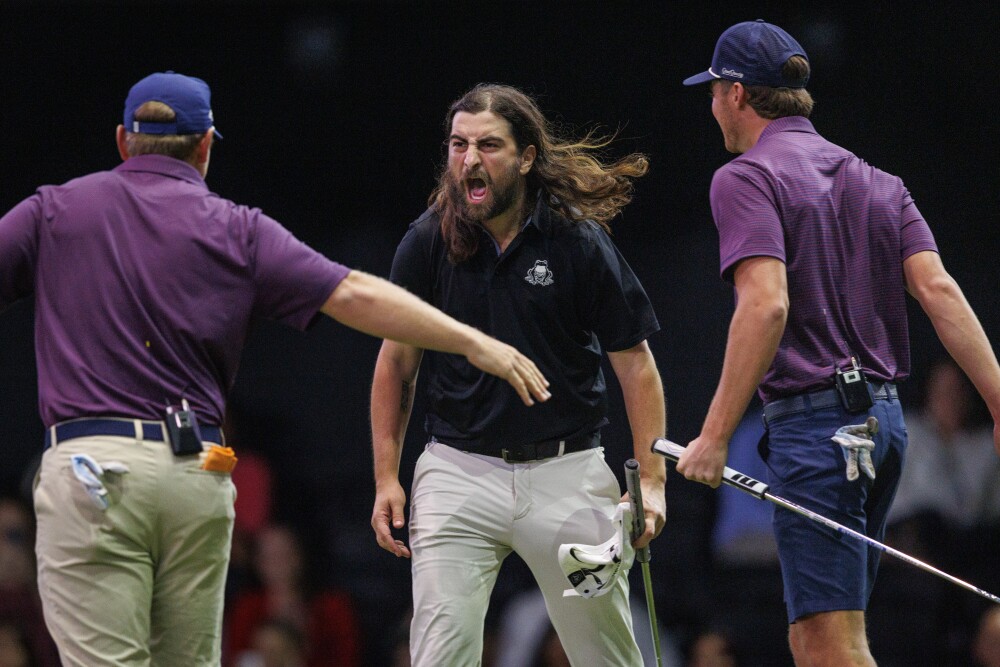
Horan and Kahan brought the Boston Tee Party plenty of mainstream star power. Among the roughly 800 fans in attendance, a fair percentage were rabid fans of the musicians – particularly the young, female cadre of Niall stans, whose enthusiasm for the former One Direction member-turned-solo artist borders on mania.
But just as many ticketed attendees seemed to be there for Good Good - hollering for the four troupe members who were competing, as well as Tom “Bubbie” Broders and Malosi “Mo” Togisala, who served as in-arena emcees.
Bubbie and Mo bounced back and forth between hyping and trash-talking their buddies, illuminating the action and fist-bumping fans. They threw the crowd plenty of red meat in the form of inside-jokes that the more devoted among their 4 million YouTube subscribers would get. There were several references to slope-enabled rangefinders – a nod to some controversy that surrounded Togisala at the recent Internet Invitational, a huge competitive gathering of golf YouTubers.
Most references sailed over my head; I sometimes felt like an old man at 36 years of age. I was fine with that - I'm a little outside of the target demographic. I was more encouraged that the competition itself was actually compelling.
YouTube golf is an interesting new frontier in the game, intensely personality-driven but still centered around competent golf. A dramatic showdown between Good Good members, edited down to an hour, may be more appealing than a four-hour traditional PGA Tour broadcast. To thousands of young golfers, Garrett Clark, Brad Dalke & co. may be as famous as Rory McIlroy and Scottie Scheffler. To traditionalist golf fans, this notion is absurd, but the numbers Good Good and other big-time golf YouTubers are pulling are staggering. Is YouTube golf an add-on to professional golf fandom or a one-for-one alternative? It's a question that both sides of golf's new media landscape will reckon with in the coming years.
To me, YouTube golf is the former: an occasional curiosity that can bridge gaps between times when I'm watching live golf on television. When I do tune in on YouTube, I'm more drawn to the interesting courses featured by creators than their personalities. I sometimes wonder whether the computer- or smartphone-screen barrier between performer and audience will end up inflating the former’s sense of importance. Will these new celebrities end up believing they’re bigger than the game?
I came away from the Boston Tee Party feeling a little less concerned on this front. Because the match was not televised, it moved along at a decent clip, just over 90 minutes with brief intermissions every three holes. And it was exciting right down to the end, with — spoiler alert — Dalke horseshoeing a must-make putt to hand the victory to Team Niall. Were there moments when some participants hammed it up for the crowd? Of course. But I perceived plenty of authentic competitive fire on both sides. In those pivotal late moments, and throughout most of the match, every player was completely invested in the outcome, which points to a universal truth of golf: the competition always matters more than the competitors. As long as the overseers of competitive golf - from YouTube to the PGA Tour - remember this, they will keep fans interested indefinitely.


Comments (0)