


 Back
Back






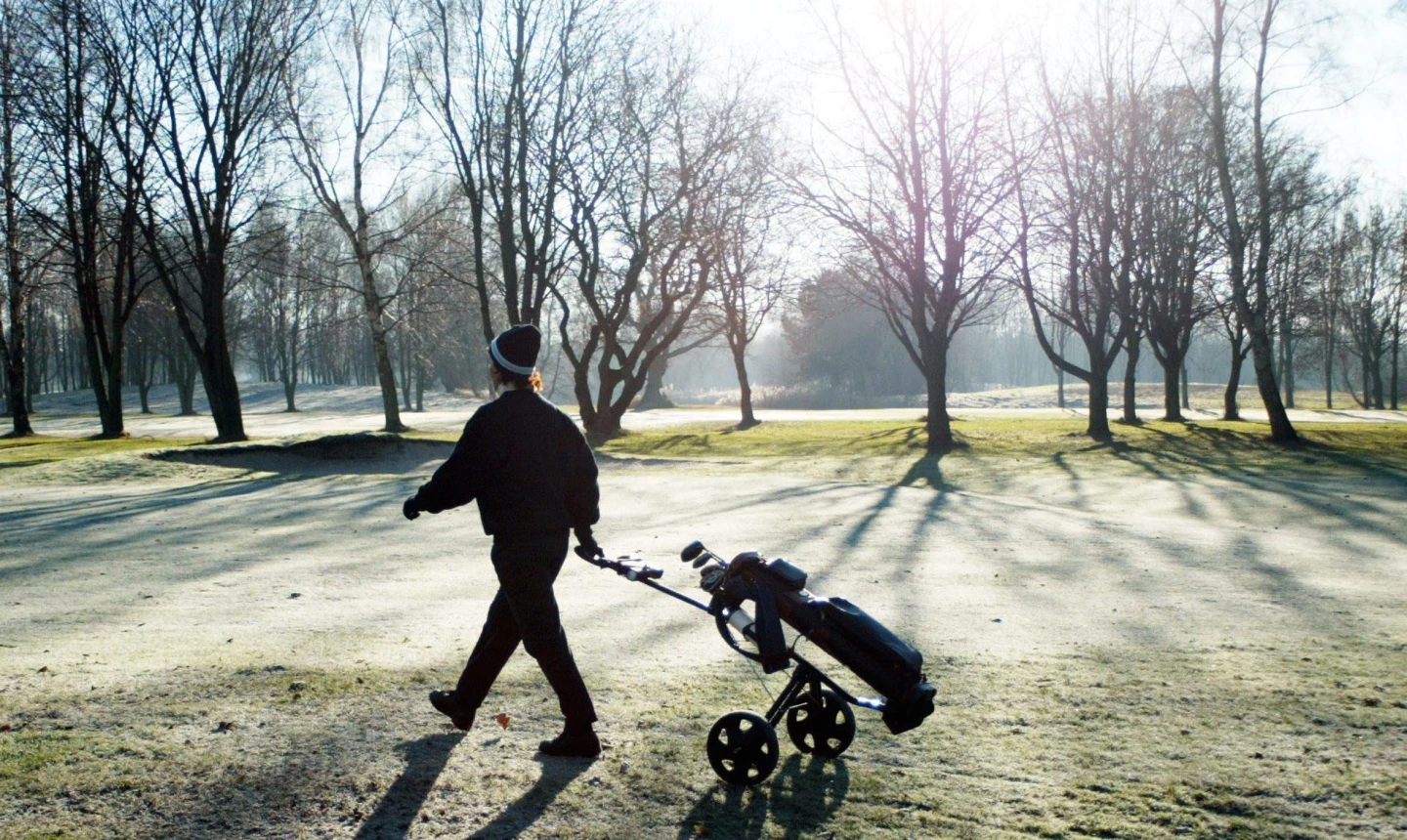
Having lived in South Carolina and Florida for the last few years, I’ve met a number of golfers who cleave to the 50 Degree Rule. If it is not at least 50 degrees Fahrenheit outside, they simply refuse to tee it up.
But having grown up in Connecticut playing late-fall junior golf tournaments and early-spring high school matches, there seemed to be a different "50 Degree Rule": The temperature on competition days seldom reached much above 50 degrees.
That being the case, I learned not just to tolerate playing golf in the biting cold and chilly winds, but to embrace it. In fact, I spent this past Thanksgiving week in Connecticut and managed to tee it up two days after Turkey Day, at Wintonbury Hills Golf Course for a blustery round that started with temperatures in the low 40s, with a high barely cracking 50.
I had a great time, and would encourage normally fair-weather golfers to try and expand their temperature tolerances – both during home rounds and on golf vacations – for three big reasons:
Why you should play cold-weather golf:
Price
The shoulder- and off-seasons at golf courses usually mean drastically reduced green fees. For example, rates at Wintonbury Hills Golf Course in Bloomfield, Connecticut, normally top out around $80 on weekends in the prime summer and early-autumn seasons. November knocks about $30 off that rate on weekends and $40 on weekdays, encouraging hardy golfers to ball on a budget at a Connecticut super-muni.
Pace of Play
Since the cold tends to keep fair-weather golfers away, no matter the price break, you can usually expect to have the course practically to yourself. A three-hour round in chilly temperatures beats a five-and-a-half-hour marathon just about every day, no matter how perfect the weather.
Conditions
For the most part, a chilly turn of the weather doesn’t necessarily mean a drastic reduction in course conditions, with one caveat: many courses will aerify their greens at the end of the season, so if bumpy and sandy putting surfaces are a deal-breaker, be sure and call ahead to get the skinny from the course you’re looking to play. If they’ve not been punched, greens might be a tad slower than normal. Tee to green, though, expect firm, fast and fun conditions, especially on a course coming out of a frost delay.
Video: Cold-weather golf tips from Chris DiMarco
How to thrive while playing cold-weather golf:
Walk the golf course
Golf carts are pretty much everywhere nowadays (unfortunately), but if you do want to venture out on a cold day, sitting in a cart is the best way to guarantee you’ll be miserable from start to finish. The physical exertion of walking nine or 18 holes will get your blood flowing and help you feel a few degrees warmer. Carry your bag or use a trolley of some kind if you like, but working your legs is the key to actually enjoying a cold-weather round of golf.
Bundle up completely
This is obvious, but while this used to mean packing on so much thick clothing that it became impossible to swing properly, modern layers are thin, warm and built to move with you. My cold-weather go-to is a long-sleeved Under Armour ColdGear base layer, a normal golf shirt and an Under Armour quarter-zip pullover. If it’s windy, I might substitute out the UA pullover for something more specifically wind- or even rain-resistant. Corduroy or flannel-lined pants usually do the trick from the waist down, but they’re not absolutely necessary because walking warms my legs no matter what.
The most important piece of any cold-weather golf ensemble, though, is the hat. My advice: ditch the baseball cap and opt for something woolen (pom-pom optional) or with a performance layer. Just make sure the hat covers at least the tops of your ears and you’ll be comfortable.
For your hands, you can go one of two ways. Activated-charcoal hand-warmers like HotHands are usually my preference, and I usually bring one for each hand. They carry the added benefit of warming my upper legs while sitting in my pants pockets, too. In their absence, though, you might prefer donning a pair of rain gloves, which will be particularly helpful if your grips get slick in the cold.
Adjust your playing strategy
In general, the cold is going to make shots play about a club longer through the air. You’ll gain some of this back in the form of extra roll off the tee and a bigger first bounce than normal on approaches, but taking an extra club should serve you well more often than not.
Since these rounds are played out-of-season as far as your handicap is concerned, don’t be afraid to stretch the rules. Preferred lies in the fairway are a given, and the Leaf Rule – a free drop if you can’t find your ball amongst the fallen foliage – is a good one to take up. Finally, if you’ve convinced your normal group to convene for one of these rounds, throw out the scorecards and play match play – best-ball, alternate-shot or a scramble. The more fun you’re having, the warmer it will feel.
Bring beverages
Golfers everywhere are toting insulated bottles these days, meaning your coffee, tea or hot chocolate will retain its heat longer than it did in the past. And if you prefer a tipple, a nip of whiskey or some other spirit has been known to warm the bones in a pinch. If you want to imbibe old-school, find some kummel, a sweet, spiced spirit beloved of golfers in Scotland.
Got any cold-weather golf tips or stories? Please feel free to share them with us and your fellow Golf Advisor readers below!
Stay in the Swing with GolfPass!
Get exclusive tips from the pros, in-depth course reviews, the latest gear updates, and more delivered straight to your inbox.


Comments (25)
Just played a very comfortable round of a walking 9 hole golf today in 28degree weather. A wool cap and socks were a given, but, clothing that has not been mentioned that are a comfortable must; flannel lined slacks (and fleece-lined are eleven warmer) and a light-weight down-microtherm-vest over a microfleece hoodie....how one layers is their choice. Played my best round all season.....just tough to find balls in the leaf-filled rough this time of the year in northwestern Wisconsin.....used fluorescent orange balls and still lost one. All clothes were black or dark green.....was 26degrees when the round ended and was very warm.
As golfers, we have to play in such a range of conditions that are unlikely to be experienced in other sports. This year, for example, I have played in temperatures ranging from -3 degrees C to 33 degrees C.
The main key to playing good golf in cold temperatures is to keep warm while maintaining a high level of mobility. When people say wear enough layers it can be misleading because wearing too many layers can hinder movement and decrease your ability to swing effectively. Personally, I find tight layers underneath my normal golf clothes to be better than wearing several jumpers. I would also advise the use of hand warmers to keep warm and I actually find that having warm hands improves my feel around the greens
Temperature also has a massive effect on distance. A ball travelling at the same speed in cold weather will not go as far as a ball travelling at the same speed in hot weather. However, in cold weather, the golfer will often be stiff and not able to swing at the same speed so it is usually advisable to take at least one extra club on shots in cold weather.
See: http://golfguides.info/best-golf-irons-for-mid-handicappers
Just played a very comfortable round of a walking 9 hole golf today in 28degree weather. A wool cap and socks were a given, but, clothing that has not been mentioned that are a comfortable must; flannel lined slacks (and fleece-lined are eleven warmer) and a light-weight down-microtherm-vest over a microfleece hoodie....how one layers is their choice. Played my best round all season.....just tough to find balls in the leaf-filled rough this time of the year in northwestern Wisconsin.....used fluorescent orange balls and still lost one. All clothes were black or dark green.....was 26degrees when the round ended and was very warm.
As golfers, we have to play in such a range of conditions that are unlikely to be experienced in other sports. This year, for example, I have played in temperatures ranging from -3 degrees C to 33 degrees C.
The main key to playing good golf in cold temperatures is to keep warm while maintaining a high level of mobility. When people say wear enough layers it can be misleading because wearing too many layers can hinder movement and decrease your ability to swing effectively. Personally, I find tight layers underneath my normal golf clothes to be better than wearing several jumpers. I would also advise the use of hand warmers to keep warm and I actually find that having warm hands improves my feel around the greens
Temperature also has a massive effect on distance. A ball travelling at the same speed in cold weather will not go as far as a ball travelling at the same speed in hot weather. However, in cold weather, the golfer will often be stiff and not able to swing at the same speed so it is usually advisable to take at least one extra club on shots in cold weather.
See: http://golfguides.info/best-golf-irons-for-mid-handicappers
Good gracious man what were you talking about 40 degrees being "really cold"... hope you've become more aware and gotten some hair on you balls in these last 6 years.
When bundling up, I also like to put on a puffy, down filled vest or even my UA Cold Weather vest. When worn together you get twice the warmth. These don't hinder or bind on the shoulders. A turtle neck or mock turtle also provide additional warmth for the neck.
From October-March, we walk our hilly home course outside Phila (PA) which keeps us comfortable down to the high 30s/about 40 degree mark. We also use hot hands to keep the golf ball warm. Good quality 3-wheeled push carts do the job.
Something I tried that seems to work in colder months in Tennessee. I have a pair of the over-sized mittens. I put a HotHands packet in each one (plenty of room). Keep my hands in there until ready to take a shot. After my shot, hands go back in and it is nice and toasty.
Watch out for extra bounce on frozen greens. On the other hand, on really cold days, you can use the now frozen water hazards to bounce the ball up onto the green.
play a very soft or womans golf ball cold weather seem to make these golf ball somewhat harder, more control less roll on your short game also insluated vest over your main torso = gives you more freedom to swing, play more of your 3 wood off tees winters here in w,v, can get a little windy, hope this helps some of you guys out there!
Merina wool sweaters or vests. Old school but FAR more comfortable and way warmer than anything artificial. if you don't believe me ask anyone from Scotland where they play in the snow. Also you could ask a Ryder Cup player from the US as they freeze their KNOTS off when playing Europe who all wear merino.
I love In Northwest Indiana, and we have a group that will play year round WP. I liked your comment about the golf carts, I walk 99% of my rounds. When your walking even mid 30’s don’t seem that bad.