


 Back
Back





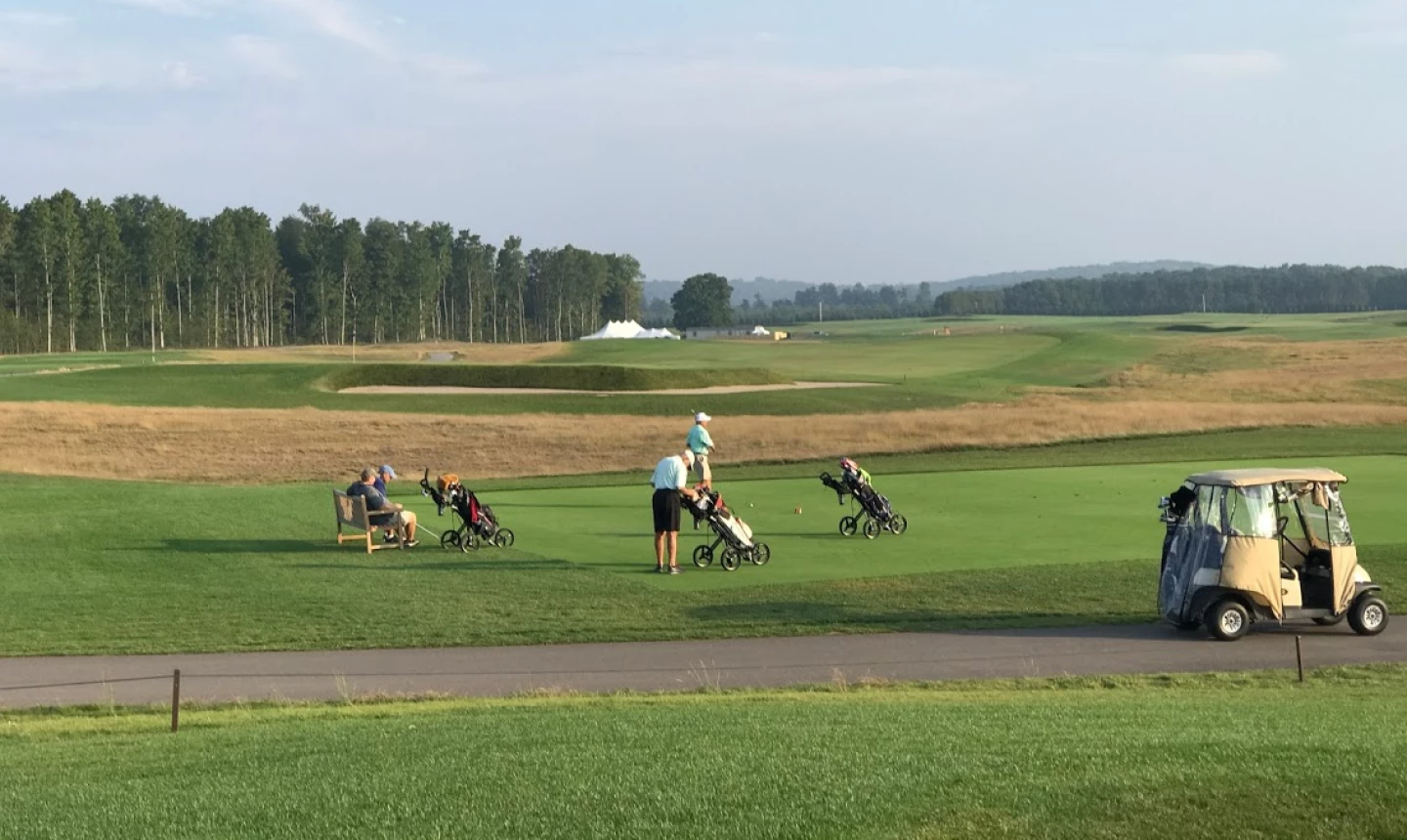
There are two conflicting realities when it comes to golf carts in America.
On one hand, the purist follows the notion that all golfers should walk and those who use carts are lazy. These people consider walking a course the game’s most noble pursuit. This army of believers has spearheaded the rise of walking-only resort courses that have become so popular – Bandon Dunes Golf Resort as the flagbearer, but also including Whistling Straits, Erin Hills, Streamsong and Sand Valley. Major championship-hosting public courses such as Chambers Bay and Bethpage Black are also walking-only.
A different truth emerges once you get out onto most of America’s other courses … munis, private clubs, resort courses … it doesn’t matter. Most golfers will take a cart if you give them the choice. So where does that leave us? Lost in golf purgatory where idealism doesn’t match the wants and needs of the masses? Are golf carts our enemy or our friend?
Learning that the two most walkable courses I’ve played within the past year – The Loop at Forest Dunes in Roscommon, Mich., and the Short Course at Mountain Shadows in Scottsdale, Ariz. – are more dependent upon carts than the architects and owners anticipated has left me more confused than ever about the place of golf carts in the game.


A new cart policy in northern Michigan
Walking the Red and Black courses at The Loop were two of my most enjoyable rounds of last summer. Playing the course clockwise one day and counter-clockwise the next was quite stimulating. I kept looking around the second day, trying to get my bearings on where I had played from the previous day. Tom Doak did a masterful job making the course walkable and playable. I shot two of my lowest rounds of the year. Alas, most everyday golfers don’t geek out on architecture novelties like I do.
The Loop only did 6,500 rounds last year, according to new Director of Operations Don Helinski, and for that reason will begin offering carts this year. It seems the tribe has spoken: They want carts. From the purist point of view, this is disappointing on two levels: The course opened in 2016 specifically to be walked with a caddie and cart traffic is known to damage fescue turf.
“We feel now that the turf is mature enough to handle the traffic,” Helinski said. “With us being in the middle of nowhere, we are relying on large groups (for business). The feedback since we announced (allowing carts) is what we wanted to hear. Group organizers would say: ‘We’ve got 30 guys, but four of the guys are unable to walk it. We weren’t going to come because of that. We want your course to be on our buddy trip rotation (now)’."
Twitter reaction has been decidedly mixed, especially since the addition of carts will affect how the course plays to a certain degree. Long grass is being grown around the edges of certain bunkers that are hidden from one direction or another. This warning sign should keep carts from unknowingly crashing into unseen hazards.
Disappointed. The change will alter the number of times I will play it in the future. Used to play the full loop 2-3 times a year.
— Jeff Rabidoux (@lifeonthe45th) January 10, 2019
Helinski hopes that adding carts will double rounds played at The Loop and lead to, at the very least, a 50-50 ratio of walkers to riders. Forest Dunes will continue to promote walking and offers a full caddie program run by Caddiemaster.
“As our business has continued to evolve and grow, we are becoming more of that destination (that attracts traveling golfers who like to walk), but we still rely heavily on the golfer from Michigan,” Helinski said. “We are spoiled with the number of high quality courses in Michigan. The norm is people take carts. The thing with The Loop, what people have said: ‘I’ve never walked a course in my life and that was the most enjoyable experience I’ve had. It slowed down for me. I was able to focus on my game and strategy. It wasn’t a race to get through it. It was more of a social experience'.”
A party cart in Arizona

That social experience is at the crux of what Mountain Shadows is all about. Arizona architect Forrest Richardson transformed a tired, executive course into a unique par-3 course that will engage any golfer from beginners to everyday players and even Tour pros and professional athletes who have teed it up. Completed in 2017, the redesign was part of a multi-million-dollar renovation of the adjacent Mountain Shadows resort that straddles Camelback Mountain.
As a par 54 of 2,310 yards, this 18-holer tries to combat the biggest complaints against the game - that golf costs too much, takes too much time to play and is too difficult. With such a small footprint, it is inherently walkable. So why does Director of Golf Tom McCahan report that 75 percent of players take carts?
“That’s what stinks to a degree. People are so used to riding. It’s automatic (to take a cart) even though it’s a shorter distance,” McCahan said. “Walking is becoming more accepted with pull carts. We have 15 pull carts. People just aren’t walking as much as they could.”
I’m guilty, too. As part of the Golf Advisor Getaway to Scottsdale in January, Matt Ginella and I arrived at Mountain Shadows with a six-some of golfers one afternoon, ready to do battle in a skins game shootout with a little cash and a lot of bragging rights on the line.
We rented a “party” cart, a larger vehicle with four seats and a rear attachment that could hold four golf bags. It was the perfect compromise, since not all of us had light-weight walking bags and everyone had already played 18 holes that morning. Ginella and another player carried and the rest of us took turns driving the cart, which stayed on the path. We finished in less than three hours, playing the final hole in the dark and paying up under the lights of Rusty’s, the outdoor bar near the tiny but cool pro shop.
On this instance, taking a cart made perfect sense, even if it went against the spirit of Richardson's redesign. In fact, the "party" carts are so popular that golfers often call in advance to reserve them. Apparently, golfers need a place to hold their beer and portable speakers as well as their bags.
A final word on carts
Consider this perspective: I can count on two hands the number of rounds I’ve walked in America the last five years. Conversely, I can count on one hand the number of rounds I’ve not walked and taken a cart on the two dozen trips I’ve taken overseas to Scotland and Ireland the past decade. Love it or hate it, cart golf is here to stay in America. There's too much in the way of cart-fee revenue, a growing pool of aging or physically limited golfers and course designs meant only for carts to see walking going full-on mainstream. Riding is the norm, while walking is marketed and treated as a luxury experience at a niche collection of high-end private clubs and bucket-list resort courses. Golfers who have walkable, affordable public courses nearby, consider yourself extremely fortunate.
I'm not ashamed to admit I like riding some rounds. I'm a fan of the Shark Experience launched by Greg Norman in 2017. Listening to music and watching live sports in an interactive cart of the future can liven the mood of a foursome playing poorly. And since I'm working 95 percent of my rounds, I need my phone to stay charged plugged into a USB port.
I'm also sympathetic to using golf carts depending upon the weather. Is it really wise to walk when the temperature and humidity soars in Texas or Florida (or any other place for that matter)? Carts provide shady relief and keep your beverages cold during the summer. Streamsong, home to its Red, Blue and Black courses designed to be walking-only, has caved into allowing more carts on its fairways during the hottest months in central Florida, accepting riders from April 1-Oct. 14 this year without time restrictions and after 11 a.m. from Oct. 15-Dec. 31.
However, my most memorable golf days have come with two feet firmly on the ground: Walking a links overseas, playing Pebble Beach with a buddy and carrying my own bag, strolling through inland dunes at Ballyneal in remote eastern Colorado, etc.
The true problems come in mixed foursomes, where one or two golfers walk and the others ride. The rounds tend to lack rhythm and socially you're split - those walking vs. those riding. It's almost as if you have to declare for 'team walking' or 'team riding' on the first tee. Can't we just all get along? After all, we're sharing the same fairways.
Are Americans overdependent on carts? Share your thoughts in the comments below.







Comments (75)
I am just delighted that Matt decided to walk the par 3. What I don’t know is whether he had to pay or not after the round. I know Matt from a long ago Ambush.
A party cart for a par 3 course? Good grief, whatever happened to our legs?
Oh, I see, it’s for our beer and speakers. What nonsense.
I am just delighted that Matt decided to walk the par 3. What I don’t know is whether he had to pay or not after the round. I know Matt from a long ago Ambush.
A party cart for a par 3 course? Good grief, whatever happened to our legs?
Oh, I see, it’s for our beer and speakers. What nonsense.
There was a time when I could run through the mountains with a full backpack. At almost 70, I can't do that anymore. In the same vein, I have a hard time carrying my bag or even using a pull cart on a longer course. On shorter courses, I still prefer to walk. I enjoy being OUT and the total golfing experience. There just needs to be a balance.
Walking is faster. It makes the game more enjoyable. Allows the player to get much needed exercise.
Now, I will add one wrinkle. Let me use a pull cart.
Some courses ban them. They insist that if a player walks, they must carry. Horse hockey. This isn't the 1800's.,
I carry accessories such as rain gear, towels, some snacks( bananas, primarily) so my bag is above average weight.
When using a conventional motorized cart many golfers are "married " to the vehicle. So much wasted time. There is the player that insists on being driven to their ball. Then there is the player that brings so much "crap" out on to the course, you'd think they were going on a two week vacation. Using carts on walkable courses is a major consumer of time.
One other issue. Course managements MUST cater to those who can play but find walking difficult. So the option of a motorized cart should always be available
I am over 70, with hammer and claw toes, and the arthritis has weakened my legs. I can't walk, but with a cart I am able to play 3 times a week, usually under 3 & 1/2 hours.
I learned the game as a walker, and I play better when I walk. In the last decade I've been trapped into riding by different circumstances (getting matched up into groups with 3 riders, courses that have restricted walking tee times, and some designs - a disastrous idea - that are meant to discourage walking. As I turn 59 in April, I have made it a personal goal to walk more rounds this year than ride. It is better for my game, my state-of-mind, and my health. Maybe I'm just OG, or old fashioned, but I don't need music, or more than one beverage to carry around. I also feel that walking actually allows me to see the course from a designers point of view, which you can't do while riding down a cartpath. Additionally, I truly despise course operators who will still charge a cart fee, even if I choose to walk. That practice is part of the reason why people who may want to walk, will decide to ride, "Since I'm paying for it anyway". There is a special place in Hell for course operators who use that "Same price, walk or ride" policy. I truly enjoyed playing golf in Scotland in 2002 and not seeing any carts on the course. Finally, there are too many riders that slow the pace of play by not knowing the best way to utilize a cart.
I can't understand it when I see athletic people in their teens and 20's riding. There is a place for riding, but it is far too common in the U.S. Get some exercise!
Our foursome can't get out to play until 3pm or after (twilight rate). We use carts in order to finish before dark.
I have worked as a "ranger" for many years at courses where walking was NOT allowed. Carts do speed up play except when the carts were confined to the paths. Walking is great for young or healthy golfers. However, at many of the resort courses you have more retirees because the young are still working. The course takes in considerable revenue from carts, the margin is huge.! They prefer carts if profit is a factor. The major problem is not using a cart properly and particularly driving the cart where it should not be taken. Damage to the course is greater with carts because people don't care. Next time on the course watch where carts are parked around tees and greens. The majority pull at least 2 wheels off the path. The grass is always damaged. Golf rounds are down at most courses,and many have closed. Eliminating carts would reduce more play.
I am a 75 year old golfer having been playing for 45 years in former years mainly in the U.K. and Spain, where walking the course with a trolley , manual and these days electric. Is the norm. Even in Spain and Portugal where the temperatures often equal those found in Florida..
I moved my golfing home to Florida some 12 years ago and was initially appalled at the lack of walking courses., with most not even allowing the option of walking. Presumably due to lack of revenue gleaned from renting out carts..I always thought that ridding meant you missed out many of the pleasures of walking the course, taking time to study your next shot while approaching your ball. I would debate that ridding leads to faster rounds. In my experience it does not.. Bernie Osborne, Naples.