


 Back
Back






One of Florida's longest-tenured public golf courses has become a battleground in the ongoing debate over the potency of today's golf club and ball.
Lake Worth Beach Golf Course was originally laid out in 1926 by William Langford and Theodore Moreau, so it is celebrating its centenary anniversary this year. Located in the heart of Palm Beach County, one of America's hottest markets, it represents one of the most affordable area golf options for locals and visitors. Its slender, sporty routing measures slightly more than 6,000 yards on barely 100 acres, occupying a north-south-oriented rectangle between neighborhoods and the Intracoastal Waterway separating mainland Florida from the upscale beach community of Palm Beach.
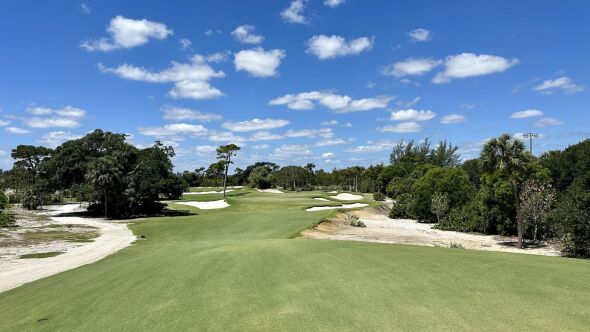
It is not a big ballpark, and it never will be, but for a century it has satisfied local golfers. One of its toughest holes on the course ever since a 1948 redesign by famed midcentury-modern architect Dick Wilson has been the 3rd, a 401-yard par 4 that is the number 3-handicap hole per the scorecard. A skinny fairway snakes between a pond on the left and a bunker, the course's western boundary and the local Parrot Cove neighborhood on the right.
Neighbors have raised their voices in frustration about golf balls leaving the property and ending up on their roofs and in their yards. A June 2025 article from local non-profit outlet Stet News details a struggle between the course, the city and its residents resulting in a plan to adjust the design of the hole for the future. The first step was to radically shorten the hole by 220 yards on a temporary basis, converting it to a 180-yard par 3 to the current green while the city reworked the main tee area, angling the tee box to the left, more towards the interior of the course property. Trees have also been planted along the right side, further encouraging play away from the homes, towards the interior of the property and the aforementioned lake. In this configuration, the hole would play about 380 yards, though local golfers remain concerned that this solution will be declared insufficient and the hole will be permanently shortened to a par 3.

Whatever happens, Lake Worth Beach's third hole becomes another counterpoint to the narrative that golf equipment evolution is only a problem for elite players. A 6,000-yard muni on tight property is not hosting big-time professional golf anytime soon; it is a public amenity. Neither Langford & Moreau nor Dick Wilson, nor the town council who supported the original building of the course, had a reasonable expectation that more and more golf balls would leave the property with each passing year, leading to ever greater tension with the surrounding community.
Golf course property boundaries an increasingly contentious issue
Less than three miles north of Lake Worth Beach Golf Course, The Park West Palm, the $50-million municipal facility built over the dilapidated former West Palm Beach Golf Club and quickly regarded as one of South Florida's best accessible golf facilities, had its own issues with neighbors. Less than two months after formally reopening in the spring of 2023, the course abruptly closed its driving range after nearby homes began taking fire from errant practice shots. The Park doubled the height of the netting along the right side of the range from 75 to 150 feet after a months-long closure.

The USGA and R&A recently announced that they would be delaying the implementation of stricter golf ball testing procedures until 2030, up from an anticipated start date of January 1, 2028 for pros (2030 for all golfers). Between now and then, it seems inevitable that more golf courses will have to reckon with the effects of ever-increasing hitting distances. The City of Lake Worth Beach has spent thousands of dollars in an effort to mitigate errant golf balls on its third hole, while The Park had to pay for extra netting. No word on whether any of those required funds have been donated by the leading golf equipment manufacturers.



Comments (0)