


 Back
Back






MYRTLE BEACH, S.C. - "GolfTown, U.S.A." is not a city of millions of people. It's the seat of a county of 350,000, home to dozens of courses (and more in the neighboring counties) that attract avid golfers from across the world every year.
In other words, it is a perfect market for a PGA Tour event.
Several decades in arrears, Myrtle Beach, one of the world's greatest golf destinations, finally joins the schedule of the world's premier pro golf circuit with the inaugural Myrtle Beach Classic May 9-12. It begins at least a four-year stint, which will carry through 2027, when Myrtle Beach celebrates 100 years of golf.
And it couldn't have a more fitting host venue in The Dunes Golf & Beach Club.
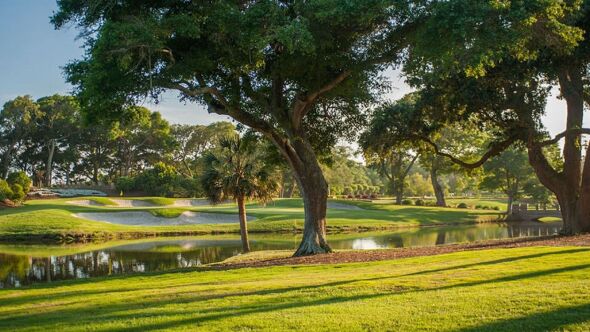

Opened in 1948, The Dunes was the second course to open along South Carolina's northeast coast. Not only did it ultimately help launch Myrtle Beach as a golf destination, it catapulted golf course architect Robert Trent Jones, Sr. to prominence as the post-World War II era's most prolific designer.
Few courses embody golf's midcentury-modern style as fully as The Dunes. It's long, lithe and exacting, with runway tee boxes and narrowish fairways that flow left and right in graceful curves. They have a habit of tilting back at the tee box in the landing areas, limiting roll-out but helpfully encouraging the sort of high aerial approach shots that the deep and imposing greenside bunkering demands. Assiduously elevated putting surfaces are medium-large but play smaller due to typically firm, fast turf and slopes that tend to reject all but the best-struck approaches. Those who drive it far and straight will prosper.
A PGA Tour event will be the latest in a long and diverse list of significant tournaments to visit the club. A U.S. Women's Open (1962), final PGA Tour qualifying (1973), the Senior Tour Championship (1994-1999), the PGA Professional Championship (2014) and the USGA Women's Four-Ball (2017) are all celebrated by the membership, with memorabilia displayed proudly in The Dunes low-slung oceanfront clubhouse.
The first eight holes are pure Carolina parkland golf, stately and tree-lined. The dogleg-left par-5 4th hole introduces the course's first water in the form of a pond fronting the two-tiered green. The front's other usual three-shot hole, the 8th, will play as a bruising par 4 for the Myrtle Beach Classic, its shallow green partially obscured by one of The Dunes' 71 bunkers, renovated most recently by Jones' son, Rees.

Things kick up a gear on the par-3 9th, where the Atlantic Ocean heaves into view beyond a fiddly, elevated green. Thus begins a stretch of scenic, dangerous holes that culminates with the world-famous par-5 13th, nicknamed "Waterloo." The hole bends back on itself around a lake to an elevated green that has only been reached in two a handful of times in more than 75 years. The five-hole run back to the clubhouse comprises three par 4s - two long (14, 18), one short (16) - a reachable par 5 (15) and a shortish par 3 (17) that will be swaddled by grandstands and hospitality boxes.
The Myrtle Beach Classic's potentially eye-opening debut

Casual observers of the tournament will quickly realize how overdue the Grand Strand and the PGA Tour are in getting together. Opposite-field events like the Myrtle Beach Classic - played concurrently with the Wells Fargo Championship, a small-field Signature tour tilt - typically make very little noise. But after years of waiting, weather willing, the community is ready to come out in force.
When the initial call went out to recruit volunteers for the Myrtle Beach Classic, all 1,500 available spots were filled in less than eight hours. That type of fervor is usually reserved for major championships and the Ryder Cup.
"We literally had over 4,000 inquiries," said Dennis Nicholl, director of golf at The Dunes. "I think that was the first sign that this was going to be something special."
Ticket sales have exceeded expectations by miles. "Initially it was going to be a few thousand tickets per day," said Nicholl. "Now they're talking 8- to 10,000 people a day; tickets are going like crazy. The support from the community has been fantastic."
In-person attendees for Saturday's third round could approach 15,000 - practically unheard-of for an opposite-field PGA Tour event.
Enthusiasm and support for the inaugural Myrtle Beach Classic extends to the greater community. Nine charities are going to receive a share of $225,000 in tournament revenue, including the local Boys and Girls Club chapter, the Champion Autism Network, Myrtle Beach-based Project Golf and more.

Myrtle Beach is also home to Horry-Georgetown Technical College, which has a vibrant turfgrass program that has turned students into golf course superintendents for more than half a century. Several current students and area superintendents will be helping care for the golf course in the lead-up and week of the tournament, gaining valuable hands-on experience at the highest levels of course preparation and setup.
"It's exciting," said Jim Huntoon, who worked as a superintendent in the Myrtle Beach area and now teaches at the Horry-Georgetown Technical College. "It's a great networking opportunity for everyone involved."
The Myrtle Beach Classic also represents a hint of what the future may hold in terms of marketing similar events. The tournament made history and headlines when it held "The Q," a one-round shootout at TPC Myrtle Beach consisting of eight current and aspiring pros and eight YouTube golf creators vying for a sponsor's exemption into the event. Journeyman pro Matt Atkins earned that spot in a playoff over George Bryan IV of Bryan Bros. Golf, as revealed in a two-hour YouTube video of the event that has gotten more than 835,000 views to date. Bryan was later awarded a sponsor's exemption of his own and will be teeing it up in the tournament as well.
Relentless talk of bloated purses and huge cash payouts and "the product" has overshadowed much of the professional golf conversation ever since the Saudi Arabia-funded LIV Golf tour began siphoning off several top-ranked players, setting off a schism in the sport that has continued for nearly three years. The 70-man field at the Wells Fargo Championship is full of high-profile players and will be worth watching in its own right. But don't sleep on the Myrtle Beach Classic, where a full field at a storied championship course in a golf-crazy destination will be bringing something a little down-home, a little ragtag and thoroughly authentic to on-site fans and TV viewers.
The 2024 Myrtle Beach Classic: TV schedule
(All times ET)
Thursday, May 9
9:30 am - 11:30 am (Golf Channel, Peacock)
Friday, May 10
9:30 am - 11:30 am (Golf Channel, Peacock)
Saturday, May 11
3:00 pm - 5:00 pm (Golf Channel, Peacock)
Sunday, May 12
3:00 pm - 5:00 pm (Golf Channel, Peacock)


Comments (0)