


 Back
Back






Despite living along the east coast of Florida, I'm not a big-time beachgoer.
But on the rare occasions when I put my feet in the sand, and the rarer-still occasions when I get in the water, I make sure of one thing:
That there's a lifeguard present.
Why am I disinclined to go swimming without a sunscreen-nosed, tan youngster overseeing things?
Because I'm not a particularly good swimmer, and I know it. If I go in the water, and something unforeseen happens, I want someone there qualified to drag my coughing, salt-nosed, foolish body out of the deadly embrace of the sea.
Granted, the stakes on a driving range are not life-and-death, but the sight of a full row of unsupervised golfers practicing their swings always gives me an uneasy, divided feeling.
On one hand, it's great to see golfers practicing for a number of reasons: the course is getting some needed extra revenue, people are enjoying a nice day outside rather than in front of a screen, etc.
On the other hand, a bogey golfer beating balls without a pro nearby and without a solid plan is likely just ingraining bad habits - an armsy, flailing lash at the ball; a rapidly solidifying slice; poor posture; awkward grip, etc.
I'm a low-handicap player myself, and I can't tell you how many range sessions I've had where I've left feeling like I'm no better a player than at the beginning. My practice habits might constitute the weakest part of my game.
It doesn't take much math education to reason that it takes less time to hit 85 shots in a round than 105, but at a time when there's such earnest desire across the industry for rounds of golf to speed up, many courses seem to be paying too little attention (read: next to none) to improving golfers' scores, and therefore moving them around the course faster.
I get it - teaching pros earn a living through revenue derived from giving advice on the golf swing. Golfer is struggling to lower his or her score, golfer seeks out pro, golfer pays pro for lessons, everyone benefits. I have no problem with maintaining the established value of individualized golf game help.
That said, at some point, leaving the mass of golfers - who will struggle throughout their lives to break 90 and are either unable or unwilling to set aside the funds to take a formal, private lesson - to fend entirely for themselves as they try to improve must start costing a course, club or resort money, both through the frustrations of long rounds and through attrition by players who eventually dismiss a given course as too difficult to be enjoyable.
What's the solution?
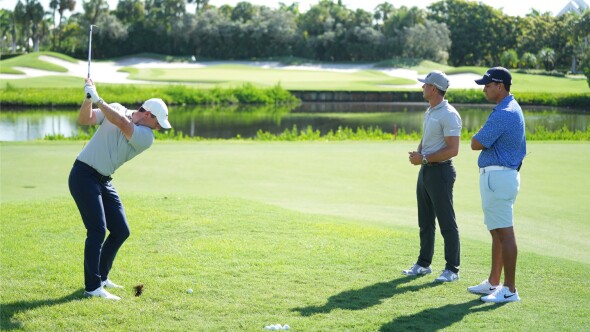
In a perfect world, every golf course would station someone - a rotation of the head pro and assistant(s) - with expertise on the golf swing at the range at all times. He or she would greet people practicing and offer quick advice - two- to four-minute mini-lessons or so - so that they could be working on something specific during practice sessions, rather than beating balls and further encoding major flaws into their swings. Nothing too in-depth - avid golfers should still have to pay for deeper advice - but these quick tips would take root, handicaps would go down and rounds would get shorter, leaving more time for hanging out on the patio or in the bar afterwards.
What's more, golfers who shoot lights-out after their mini-lesson might just end up scheduling a real lesson with the pro, generating the sort of revenue both the pro and the facility are looking for.
Now, without having first-hand expertise in running a golf course, I have a feeling this isn't really feasible at any but the highest-end, biggest-staffed clubs. A couple such clubs that I have visited indeed do encourage their pros to chat and advise members about to head out for their rounds. Having that authority figure out among the golfers adds energy to the scene and heightens the whole experience.
Smaller-budget courses, naturally, have fewer staffers, and the staffers who do exist are often swamped with issues that keep them in the shop all day. In these cases, both employee and customer lose out. The pro doesn't get to do the work of actually teaching people to play better golf, and the customer misses out on that on-the-range interaction that will endear him or her to the pro and, by extension, the facility.
Is there room for compromise here? Could public and resort course pros hold "outdoor office hours" a couple times per week, where they would separate themselves from the check-in counter for a bit and roam the practice facility, glad-handing with golfers and salving swings?
How to make your range sessions worthwhile
Do you feel like you're merely treading water - or worse - in your range sessions? I asked top golf instructor Andrew Rice, a member of the GolfPass faculty of teachers, for his thoughts on the subject of practice. Keep these in mind the next time you head to the range, and you might just start making real, permanent improvement.
What do golfers need to be careful of when going to the range if there’s no pro or instructor around?
Andrew Rice: Be wary of only working on your golf swing! Each practice should include some swing work, but also a segment for skill development and some time dedicated to executing result oriented shots.
What should golfers do if they feel themselves getting frustrated on the range?
A.R.: Step away. Go and chip and pitch for awhile and then adjust their expectations. Frustration occurs when expectation does not align with reality!
What about quantity vs. quality? When might it be beneficial to hit a bunch of range balls in a session, and when might it be preferable to hit just a few?
A.R.: The key when practicing is engagement. If you can remain fully engaged for a few hours then have at it. Most often I would encourage shorter or more segmented practice sessions to stimulate engagement.
You sing the praises of the 9-Ball Drill (hit 9 different shots with one club: high, medium and low draws, fades and straight shots). What do you like about it?
A.R.: Every shot is different and the golfer simply must be engaged and 'into' what they're trying to achieve.
What are the best cheap-and-cheerful range aids?
A.R.: Best teaching aid on the planet is an alignment rod! So many weird and wonderful uses.
(If you're interested in learning more from Andrew and several more of the world's top golf instructors, make sure you sign up for GolfPass so you can access all their videos.)
Would you like to see pros and their assistants hanging out at their courses' practice facilities? Do you feel like your range time is possibly hindering your progress? Let us know below in the comments!
Stay in the Swing with GolfPass!
Get exclusive tips from the pros, in-depth course reviews, the latest gear updates, and more delivered straight to your inbox.


Comments (30)
Completely agree with this article. As someone relatively new to the game I would love a quick 5 minute tip from a roaming coach.
And because I now know who he/she is then I would be more likely to ask for a 121 session.
Great idea.
Michael, if your so concerned about everyones swing then you stand out there and give your advice for free. Unfortunately as a fellow pro I know I speak for my colleagues when I say pay us and we will help you. Nothing comes for free. I know a club champion who comes over the top severely and still shoots even par. If you think you can fix everyone then by all means have at it. I will still charge my hourly rate to stand out there in the elements and gladly fix or help anyone who wants it.
Completely agree with this article. As someone relatively new to the game I would love a quick 5 minute tip from a roaming coach.
And because I now know who he/she is then I would be more likely to ask for a 121 session.
Great idea.
Michael, if your so concerned about everyones swing then you stand out there and give your advice for free. Unfortunately as a fellow pro I know I speak for my colleagues when I say pay us and we will help you. Nothing comes for free. I know a club champion who comes over the top severely and still shoots even par. If you think you can fix everyone then by all means have at it. I will still charge my hourly rate to stand out there in the elements and gladly fix or help anyone who wants it.
Not really. Only if a person asked for help. Most people go to a driving range to get away and don't want to be bothered. I wouldn't want anyone standing over me and watching me.
Being a golf instructor myself I agree with this and disagree with this. Not because of revenue for instructors because any instructor already knows that it's hard to just be able to make a living just teaching. Which is why many have to resort to doing something else around the course to pay the bills. I would disagree with this because I haven't met one high handicapper who would actually go for this. They already feel embarrassed and think they suck. To have someone there just reinforcing that would be doubly as embarrassing. This could lead to them not coming back to the facility or giving up the game entirely. Most of them just want the satisfaction of hitting a ball well on their own even if it takes an entire bucket of balls to do so. It's a shame that rounds have to take so long because people stuggle to play this great game, but it would be way more beneficial if everyone had to take a quick lesson on Pace of play. They may find that the game is more enjoyable if it doesn't take all day no matter how they play and might even try harder to get better knowing they don't have time to just keep dropping another ball and disregarding their last bad shot.
Have you ever thought that it might be relaxing to unwind and smash a few balls down the range? You don't necessarily go to improve every time, it would become a chore for many people.
It's a good idea as long as there is a protocol for soliciting these quick tips. Personally, my range sessions are always focused. I film my sessions and then work with my pro and his methodology on what to improve next. I am not interested nor welcome any advice other than my pro's. If I have a bad session, I know why, know the drills to fix it, and want to be left alone. As long as these floating pros have a non invasive protocol at the range, I agree it may be helpful to most.
I don't know how many times I've been on the driving range practicing and when I hit up terrible shot asking myself what I did wrong if there was somebody there to at least give me some advice on what I was doing wrong that would be great! I love the idea of short little lesson just something to straighten you out at the present time
Support the PRO!
They got eat too!
I am totally in agreement with this idea. Offering a quick tip or mini lesson by one of the golf course pros would not only be of personal benefit but generate loyalty to the course. With courses closing everyday due to lack of interest among the younger generation, this personal attention may well help build new golfing guests and improve upon slow play usually attributed to poor play.
This is one of the dumbest articles on golf I’ve personally ever read.
ALWAYS, in every sport, PRACTICE MAKES YOU BETTER! Even developing a bad swing will improve ball striking and a golf score.
Should a bowler always have an instructor available? A tennis player? A basketball player?
If a player intends to turn professional, yes work regularly with an instructor. However, to go have fun with friends or just to ‘not be embarrassed’ with business associates practice of any kind is helpful. I always suggest any golfer ocassionallly get some swing analysis, but to say working alone is harmful is not helpful.
Golf ranges need help from your publication, what in the world is your motive to discourage anyone from trying to become better.