


 Back
Back





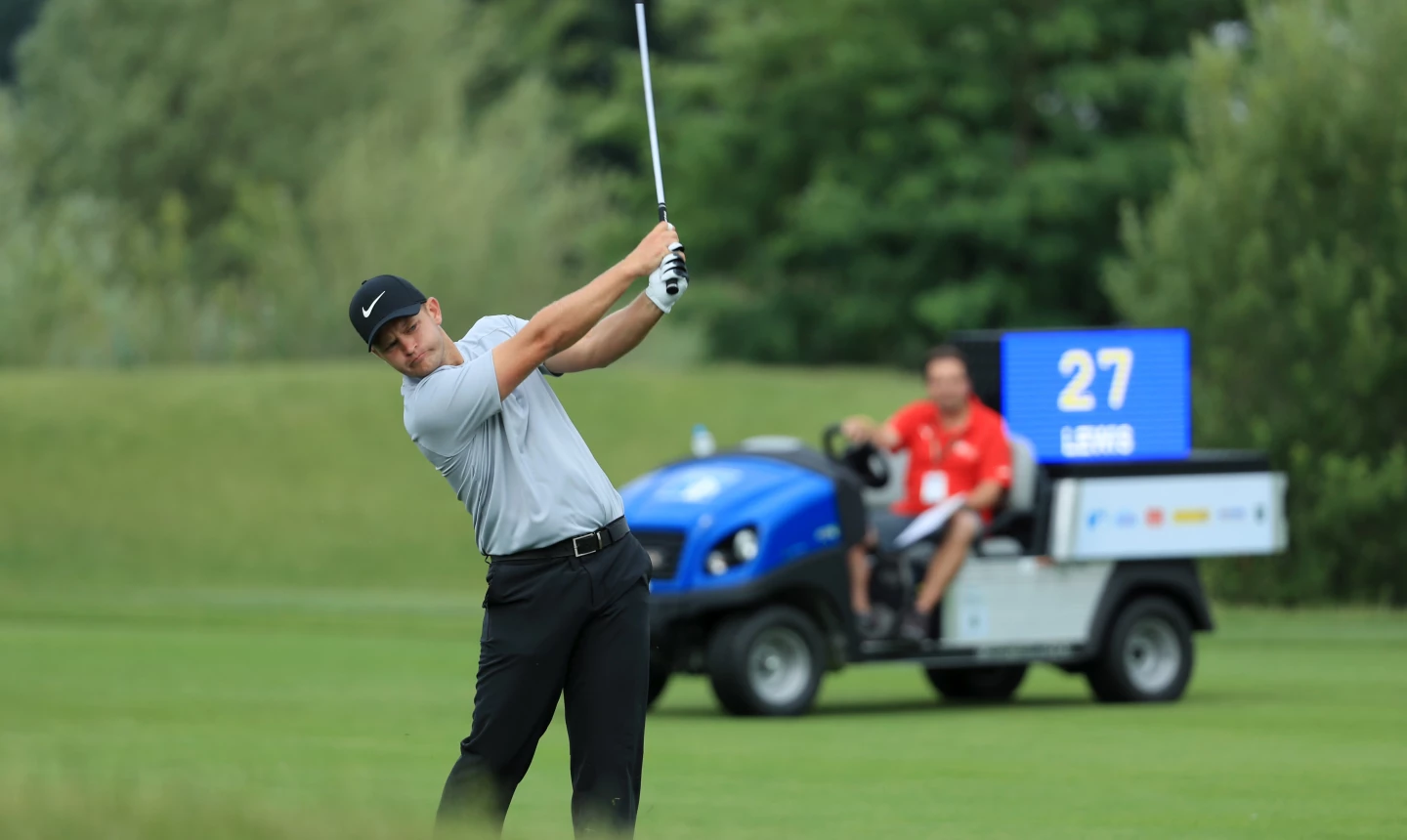
Kudos to the European Tour for trying something outside the box with the "Shot Clock Masters."
Now, while I don't think a big, electric blue shot clock behind the golfer is what the Scots had in mind when conceiving this game of leisure several centuries ago, drastic times call for desperate innovation - or at the very least some spitballing.
Pace of play has been a hot topic in pro golf so far in 2018. Earlier this year, J.B. Holmes spent four agonizing minutes in the breezy fairway of the 18th hole at Torrey Pines - only to hook a layup into the rough.
More recently at The Memorial, Patrick Cantlay began rubber-necking from ball to pin upwards of 13 times before pulling the trigger. Holmes, also a contender on the weekend, had his moments too.
It's safe to assume pace will slow to a crawl during the U.S. Open at Shinnecock Hills.
Slow play isn't going anywhere, but it's still worth pointing out the success of the format. Statistics released by The European Tour prove that being on the clock made a difference. Last year, rounds averaged four hours and 40 minutes. In 2018, it took an average of four hours and 15 minutes to complete the first three rounds with threesomes, a 25-minute difference. What's really interesting is the scoring improved while the players went faster, averaging 72.24 for the tournament as compared to the 73.37 scoring average at the tournament from 2010-2017.
Patrick Cantlay.... pic.twitter.com/AZN5XdscF6
— Ross (@RJHINDM) June 3, 2018
The truth of the matter is the pro tours can saber-rattle all they want about pace, but until players are penalized shots regularly, it's not going to improve. But before we shame players caught in the act of extended routines, consider Rex Hoggard's column for GolfChannel.com. He argues that less emphasis should be placed on players' routines and more so on the amount of overall players on the course at once:
Officials will explain much of this hold up is the byproduct of math. On Sunday, there were 25 groups on the course at one time. Even with 10-minute intervals between groups, that’s going to lead to eventual congestion by the time each wave clears their opening nine holes... As much push back as Holmes received on Sunday when he was paired with Tiger Woods, it’s worth noting that Woods’ group waited on the fifth tee, in the fifth fairway, on the eighth tee ... you get the picture.
As much push back as Holmes received on Sunday when he was paired with Tiger Woods, it’s worth noting that Woods’ group waited on the fifth tee, in the fifth fairway, on the eighth tee ... you get the picture.
These holdups can occur due to aspects that are singular to pro golf: calling over rules officials, waiting for galleries or TV crews to get set, or a course's routing that might require golfers on a green near a back tee close by to pause for one another.
#LiveUnderTimePar
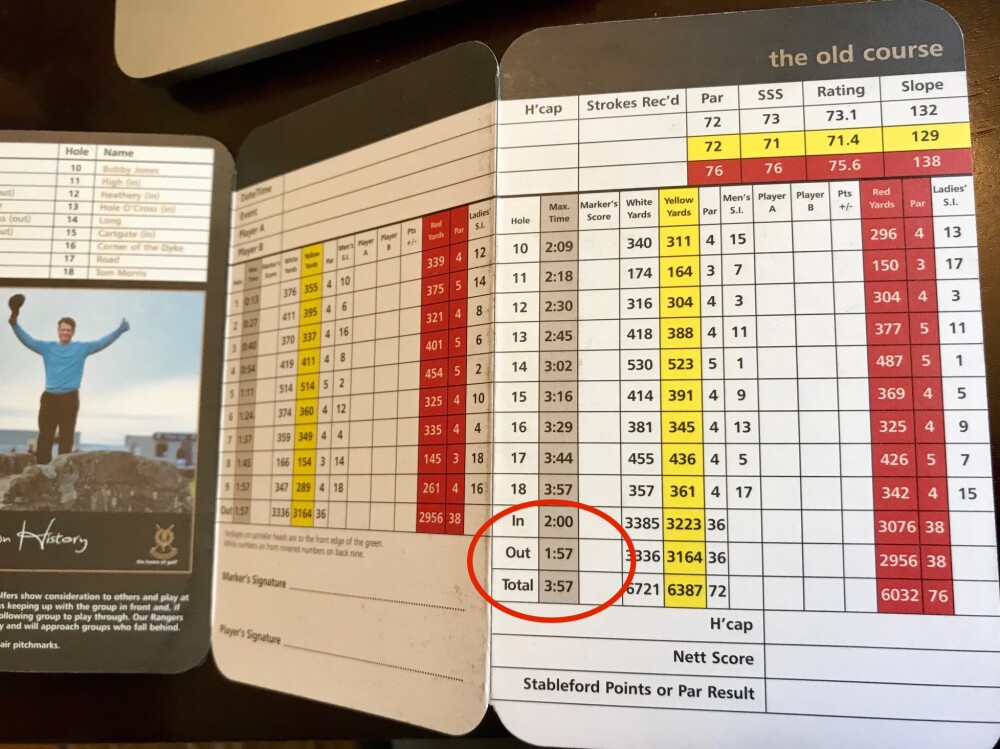
I've never played golf with a shot clock (and it sounds awful frankly), but a recent round at the Old Course in St. Andrews came pretty close. When we walked off the 18th hole, my partner tallied up five times we were asked by a marshal to speed up play. We finished in 4 hours, 5 minutes, just outside the Old's expected pace of 3:57 posted on the scorecard. (And can I just say that I love that the Old is willing to promote a sub-4-hour pace? Have you ever seen courses with a 4:45 "time par"? Not exactly aspirational.)
If you've played the Old you already know this, but this is probably the most aggressively-marshalled bucket-list course on the planet. Many high-end courses in North America who collect $250-plus green fees may be bashful about cattle-prodding its paying customers. Not here. In fact, after the 9th green, a marshall wouldn't let someone in our group use the bathroom behind the green until we teed off on 10.
I don't think we were playing too slow. Frankly the round felt a bit rushed (a society of ladies two-ball matches followed us). We were paired with two older gentleman who took their time over their balls and would walk off shots if they were within 30-40 yards of the green. My partner and I took less time to hit and walked faster, but on occasion our ball was in an adjacent fairway and we had to wait for foursomes to tee off. The organized chaos of the out-end loop from Nos. 7 to 11 usually causes backups, too.
I also suspected that by not having a caddie in the group, it probably made the course marshals more wary of us. For courses with mandatory caddies or forecaddies like the Ocean Course at Kiawah Island, caddies are there to keep an eye on pace as much as they are to carry the player's bag. More and more caddies are equipped with "Tagmarshal," a GPS beacon that helps rangers keep an eye on bottlenecks without even having to hassle foursomes.
But one thing I've noticed about the Old Course compared to commonly-known five-hour rounds stateside like Pebble Beach or Whistling Straits is that whenever I speak with someone about their memorable Old Course round, they usually tell me they played pretty well. Not only does the design warrant chances for all abilities to fare okay, it's also because there is a rhythm golfers find on the Old vs. the more stop-and-go nature of difficult, bucket-list experiences over here.
Pace of play culprits in the amateur game
Recently, a golf course in New Jersey closed nine of their 18 holes, citing time constraints of the modern golfer and particularly the Millennial.
But speaking as a borderline Millennial myself, "value" isn't about playing half the holes in half the time, it's playing the same amount of holes in half the time.
It's a challenging proposition, and one that requires everyone in the daily-fee ecosystem in harmony, from the player to management to the architect and developer.
Management-wise, lower-end facilities might jam too many foursomes into a packed tee sheet in 6- to 8-minute intervals. Or, championship daily-fees might set the course up too difficult with thick rough or difficult pins on weekends.
Even the beverage cart can cripple the flow. Has your group ever ordered four different mixed drinks in the fairway on a Saturday afternoon? It takes 10 minutes to get moving again.
As for the paying golfer, two of the biggest hang-ups I've noticed are:
1. Many American golfers are only playing a few rounds a year and thus don't feel the inclination, nor do they have the know-how to play efficient golf.
2. Entirely too many golfers don't know the little things that lead to sharing a golf cart efficiently.
Lastly, and this both crucial but ultimately the toughest to fix, architects or developers who route the course poorly cause bottlenecks or unnecessary walks or drives between holes.
Often times I hear golfers talk about amateurs taking too much time reading putts, stalking the hole from all angles like Jordan Spieth, but frankly I think most amateurs don't take enough time on the shot itself. In Hoggard's column, he reports the average PGA Tour shot takes 38 seconds (42 seconds on the tee and 32 on the greens). Average golfers take more shots and play in foursomes, but if they could have a repeatable pre-shot routine around 25-30 seconds, that would be excellent.
We're in the thick of the summer high season in the northern U.S. and Canada and surely tee sheets are going to be packed. If you do the little things right before you get to your golf ball, you should have plenty of time for waggles, looks at the hole and the like for each of your shots.






Comments (253)
Is there a problem? I think not in many cases. It's mostly just a matter or one player/group deciding the other is too slow, because they simply want to go faster than the group ahead of them. Let's use the comment below where one stated that they were the second group out and waited on every hole but one and thus the group in front was too slow. Never in the comment does it even indicate how long it took them to play. It could have been three hours for all I know. Let me just say, golfers should have to wait. If you are waiting, that means you are keeping up with the group ahead of you. If you are not waiting, in reality you could be the problem. Most golfers have all decided their pace is the correct pace and that they prefer to be the problem, meaning they don't have to wait, rather than being behind what they consider to be the problem. I would go so far as to say that none of us could even agree on what is proper pace. We just feel it is our pace and anybody slower is a problem and anybody faster by pressing us from behind is a jerk. Because golfers are people and people are egotistical, I pose that we could never even agree on the proper pace of play in golf and thus never solve the pace of play problem as it is really just a bunch of people mad at each other because we have different opinions and all of us think we're right. Is it 4.5, 4.0 or 3.5 hours? Maybe even 3? Maybe it even changes based on how we feel or if we're a twosome or need to get to work?
Judging by the number of comments slow play is a hot topic. I played a round yesterday, waited for the group in front of us, a foursome, on holes, 1, 2, 3, 4, 5, 6, 7, 8, 9, 10, 11, 13, 14, 15, 16, 17 and 18. What happened on 12 you ask, well, we got into a little trouble on 11, when we arrived at 12 tee the group in front had finished the hole, it was clear from tee to green, but then we had to wait on 13 to hit our second shots.
I should point out that the offending group were first out of the gate and there was no one in front of them for the entire round.
Arriving at the club house, I indicated my disappointment at their lack of etiquette with respect to pace of play. There was no acknowledgement, only a few excuses trying to rationalize their slow play and then they concluded that I was inconsiderate and disrespectful for pointing out the errors of their way.
No wonder there is a slow play problem, with attitudes that constantly indicate slow play is the fault of the course design, the management of the course or some other excuse, it will continue and probably get worse.
Time to remove golfers from the course if they cannot maintain a reasonable pace of play.
Is there a problem? I think not in many cases. It's mostly just a matter or one player/group deciding the other is too slow, because they simply want to go faster than the group ahead of them. Let's use the comment below where one stated that they were the second group out and waited on every hole but one and thus the group in front was too slow. Never in the comment does it even indicate how long it took them to play. It could have been three hours for all I know. Let me just say, golfers should have to wait. If you are waiting, that means you are keeping up with the group ahead of you. If you are not waiting, in reality you could be the problem. Most golfers have all decided their pace is the correct pace and that they prefer to be the problem, meaning they don't have to wait, rather than being behind what they consider to be the problem. I would go so far as to say that none of us could even agree on what is proper pace. We just feel it is our pace and anybody slower is a problem and anybody faster by pressing us from behind is a jerk. Because golfers are people and people are egotistical, I pose that we could never even agree on the proper pace of play in golf and thus never solve the pace of play problem as it is really just a bunch of people mad at each other because we have different opinions and all of us think we're right. Is it 4.5, 4.0 or 3.5 hours? Maybe even 3? Maybe it even changes based on how we feel or if we're a twosome or need to get to work?
Judging by the number of comments slow play is a hot topic. I played a round yesterday, waited for the group in front of us, a foursome, on holes, 1, 2, 3, 4, 5, 6, 7, 8, 9, 10, 11, 13, 14, 15, 16, 17 and 18. What happened on 12 you ask, well, we got into a little trouble on 11, when we arrived at 12 tee the group in front had finished the hole, it was clear from tee to green, but then we had to wait on 13 to hit our second shots.
I should point out that the offending group were first out of the gate and there was no one in front of them for the entire round.
Arriving at the club house, I indicated my disappointment at their lack of etiquette with respect to pace of play. There was no acknowledgement, only a few excuses trying to rationalize their slow play and then they concluded that I was inconsiderate and disrespectful for pointing out the errors of their way.
No wonder there is a slow play problem, with attitudes that constantly indicate slow play is the fault of the course design, the management of the course or some other excuse, it will continue and probably get worse.
Time to remove golfers from the course if they cannot maintain a reasonable pace of play.
In my opinion one of the biggest problems, as a golfer out on the course, is that you have nothing to really gauge your pace of play by, other than the players in front or behind you. It is with this in mind that I've developed a Pace of Play Timer that I believe goes a long way to eliminating any grey area regarding Pace of Play. As far as I am aware, it is the only application available where a golfer can, on any hole, see if he/she is ahead or behind the set pace of play. For those of you that read this post and are interested in finding out more about the Timer, you can do so at ecaddy.co.za/pop
I’ve read most of the comments and agree with 99.9%. Why not an article compiling a list of dos and dont’s for efficient play. The first being Cary management and “shared” driving. Next I like the comment about Club in hand. Expand on that one by saying drive with the last club you used and exchange it at the next shot. Another is to play ready golf then help others look for a lost ball. Chances are they will find it before you get there. Enough examples, how about a full list of the tips of do’s and dont’s??
Just played Shoal Creek (Caddies required) 3 days after the US Women's Open. We played with another couple (we were a three ball) and with the rough still up and wild shots frequently, we still played easily in under four hours. I am convinced that carts have made the game much slower - cart etiquette and pace of play be damned with most groups .
How many times have you watched a player hit a shot, walk back to the cart and place the club in the bag. Get in the cart proceed to your next shot. If it is on the green well done,park the cart in designated spots or behind the green if no designations are visible. Golf is a game with rhythm and movement Move it
Have not done enough to promote Tee it forward. I' m 67 and can still drive 200+ yards and usually play the white tees,.I play at a muni and often play wth gentlemen 75 and over most of whom drive 150 yards or less and insist on using the white tees when gold(senior) tees are present. Let's promote tee it forward
Two things. Play ready golf. Go to your ball and prepare for your shot. Don't walk with or wait for the other players to play before you move to your ball. Second, place your clubs, walking cart or golf cart on the back side of the green so you walk off towards the next hole rather than leaving thinks in front of the green.
GET A LICENSE! I'm serious; get some accreditation from a golf pro after having taken some golf lessons and gone through some discussions on etiquette before you can be allowed on a golf course during peak time. This is the rule in many European countries and would ensure fellow golfers respect the sport and more importantly each others.
GET A LICENSE! I'm serious; get some accreditation from a golf pro after having taken some golf lessons and gone through some discussions on etiquette before you can be allowed on a golf course during peak time. This is the rule in many European countries and would ensure fellow golfers respect the sport and more importantly each others.