


 Back
Back






Is there such a thing as an "Augusta-like" experience public golf?
There are certainly private courses that have warranted comparisons to the Augusta National Golf Club over the years: Sage Valley, Muirfield Village, Peachtree, Bluejack National, etc.
There are also replicas of Augusta's most famous holes scattered throughout the world of public golf.
But the pie-in-the-sky idea of a completely Augusta-like day for the masses remains elusive. It's not for a lack of looking. A search within our 1.4 million GolfPass reviews shows the word "Augusta" appears in over 1,500 of them. It's often used to describe an exemplary part of the round, like ambiance or conditions. (Or, in the case of the 100 or so 1- and 2-star reviews with the word, it's a facetious remark.)
Developers and architects often find inspiration for their properties and operations from The Masters. You could theoretically compile an Augusta-like day by pulling elements from a handful of public courses.
It might look something like this:
The day begins with a drive down an iconic entryway like Magnolia Lane. The closest interpretation would have to be the Caledonia Golf & Fish Club on Pawleys Island, S.C. The stately mossy oaks will lower anyone's blood pressure and set the stage for a special day:

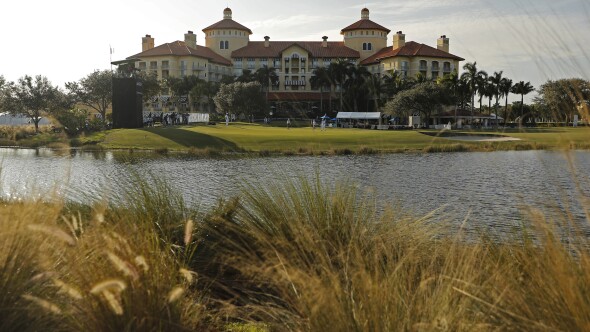
At the end of Magnolia Lane is the old clubhouse, modest compared to the club's lore, it has nevertheless been mimicked. Near Houston, the semi-private Augusta Pines Golf & Country Club molded theirs in the National's style:

As for a wide-open tee sheet, a golf course with few tee times is a non-starter for 99.99% of public golf operations. But there are exceptions in the casino-golf world, like the Pete Dye course at French Lick in Indiana and Fallen Oak in Mississippi, where accounting is managed a little differently. But the most notable example is in Las Vegas at Shadow Creek. For the handsome green fee of $500 (plus a required stay at an MGM property), there are just a handful of groups per day. You can only enter the gates via a limo, and the staff on hand knows your name.

The game is best played with no waiting, but also on foot with a veteran caddie. Caddies at Augusta are required to learn the intricacies of the game's most perplexing putting surfaces. The best public courses, from Bandon Dunes to Harbour Town Golf Links at Sea Pines Resort, have help on hand. But the one place in resort golf you're most likely to get invaluable expertise is at Pinehurst. Its No. 2 course is a place where there have been caddies for a generation-plus. (Both times I've played the course, my caddie there has been excellent with both history and strategy.) Legendary looper Willie McRae retired in 2017 after 74 years of daily duty. But there are many others with a deep knowledge of similarly perplexing Donald Ross-designed green complexes.

As for the course itself, perhaps the ultimate compliment a golf course can receive — exaggerated as it often is — is that the greens were "Augusta-like." A golfer translates that phrase to mean pure, lightning fast, and also large and treacherous. Tom Doak is a modern-day architect who doesn't shy from big, complicated greens. A recent round on the quick surfaces at Streamsong Blue featured approach shots and putts with plenty of looming peril. Doak is just one of many architects who have favored a return to a larger, Augusta-like scale, both on the greens and in totality. New builds like Erin Hills, Chambers Bay, Cabot Cliffs, Streamsong Black and Mammoth Dunes all serve up their own flavor of mega-sized features.

It's not just the scale but MacKenzie's total routing of Augusta itself that is the secret sauce. The brilliant path for both spectators and players, in concert with its 170 feet of elevation change and meticulous attention to detail across 345 acres, is something that, in spite of however many iterations of design tweaks/lengthening the course receives in its lifetime, will persevere. Augusta's clubhouse is set well off the course so as to not intrude on the flow. The routing constantly changes direction. There are no roads to cross or houses in view (okay, maybe a couple). The 345-acre parcel is encircled by trees and slopes from Washington Road down to the 12th green.
Rolling land with tall pines on a rectangular parcel wouldn't seem so hard to mimic but its aura is unmatched nonetheless. But some treelined, hilly courses have their little pockets.
Robert Trent Jones Sr. built the Gold Course at Golden Horseshoe not long after his stint of influence at Augusta National. He was never short on hyperbole and compared his Gold Course built for Rockefeller favorably. There are similarities though: plenty of heroic shots to greens hugging water and tee shots that bend up, down and around tall pines. A trio of par-3 greens all gather in a waterly low point to create an amphitheater effect. In the Midwest, SentryWorld's commitment to course conditions and aesthetics in an all-golf, parkland setting certainly earns a nod, while The Golf Club of Houston's mimicking of Augusta turf and setup has won the approval of the game's best players. Sea Island's Seaside Course is a peer in a sense that it was an aspirational, golden era design that was ultimately modernized by Tom Fazio and remains a pro test with classic bones.

Not far from Augusta, our own Senior Writer Mike Bailey was smitten by the University of Georgia course in nearby Athens, and despite the bargain green fee, found the site to be similarly rolling and dramatic.
"There are putts on these elevated undulating greens that are probably every bit as hard as some of the ones at Augusta and holes that require you to work the ball like you were at The Masters. No wonder so many great players have come out of the Bulldog golf program."
Northern California's Pasatiempo, meanwhile, might be the closest public example of what Augusta originally was prior to decades-long design edits.

"Amen Corner" is the three-hole stretch of golf by which all other trios are measured. But two others in the public realm hold their own.
The closing holes on the Stadium Course at TPC Sawgrass feature a reachable par 5, a humility-laden par 3 and a par 4 with nowhere to hide. We've seen hopes to win golf's largest purse fade away on the island green 17th hole just as "Golden Bell", Augusta's par-3 12th hole, has claimed many victims in April. On Sawgrass, turning the dogleg on the 16th hole to reveal the island green 17th and grassy amphitheater incites goosebumps. Or is the most dramatic three-hole stretch with a par 3-4-5 at Pebble Beach Golf Links, starting at the towering par-5 6th hole to the tiny 7th and finishing with the daunting, cliff-hugging 8th?

Golfers are willing to pay a huge premium to walk in the footsteps of the game's greats on the grandest stage. Not even Sawgrass and Pebble can match the rich tournament lore of Augusta. But there is one peer in the world whose history is unmatched, and it remains wonderfully populist: the Old Course in St. Andrews. When Bobby Jones helped to conceive Augusta National, The Old Course was a major influence. Granted, the topographies between the links and inland Georgia couldn't be more different. But angles of attack and big greens were among the many similar elements found in Augusta's original design.
St. Andrews' Swilcan Bridge is so old it makes the Hogan, Sarazen and Nelson bridges at Augusta seem like new builds. And the truly wonderful thing about St. Andrews is that while very few people will ever walk over Rae's Creek, the general public can do so any Sunday on the Old Course when it's closed and reminisce about their favorite legends doing the same.

But 18 holes at Augusta is hardly the whole story. As we're reminded one Wednesday every year, Augusta has 27 holes, not 18. The best golf clubs have a fun short course like Augusta's famous par 3 setup. In Spain, Valderrama was modeled in many ways after Augusta National, and that includes a par-3 course created in similar fashion. But short courses are a growing presence at many of the game's great resorts. Many of Alabama's RTJ Golf Trail facilities have a short course.
With golf out of the way, the perfect cap on a great day is a cozy, onsite place to stay the night. The Crow's Nest is one of the tiniest and yet most famous dormy-style accommodations on earth. It's a tiny, 11x11 room reserved for amateurs playing in their first Masters. There really is nothing like staying in a small inn. One of the newest major championship venues, Erin Hills has an "attic suite" above the pro shop. It's in such a remote and quiet place it might ooze some spooky vibes.
So there you have it. You may not be able to find the total package at any one public course, but a select combination of these dozen-or-so facilities pieces together something reasonably close. Few golfers ever walk the grounds at Augusta and just a fraction of those lucky few ever hit a shot there, but we still see Augusta everywhere in our own games. Local Golf Advisor 'BrandonWebb' describes Alabama's Limestone Springs as the "Most Augusta-like public course in B'ham." Or how about a reviewer describing The Ranch in Massachusetts as "Augusta like...walking on a sponge."? Or Tennessee's GreyStone having "Augusta-like speed on these greens."?
When I'm the first out on a freshly-mown course on a quiet, sunny morning, it's hard not to feel the azalea vibe. An Augusta-like experience, if just for a fleeting moment, is possible anywhere.

Bradley S. Klein, Mike Bailey, Jason Deegan and Tim Gavrich contributed to this story.






Comments (9)
The most Augusta like course in the world is Dancing Rabbits Azeleas course in Philadelphia, Mississippi. It is perfectly manicured like the national, it has the high top oaks, white sand bunkers, and as much elevation change as Augusta. It is a course with no houses on it and everything feels the exact same. The clubhouse has a magnolia lane charm to it (tree lined) and they every use pine straw to outline the rough. Oh, and the name of the course, “Azeleas” should give you some concept as the the flowering one would expect to find laden throughout. And for one last good measure, they use yellow flags and flagpoles. This course is truly the Augusta for the public. Just writing this makes me want to go back and play it again.
Sir
Reading about exiting golfcourses always brings me back in the end to my own course Broekpolder in the Netherlands. Jealousy and hope are the main emotions that go through my mind.
I have a question: At the moment we are considering a major ‘overhaul’ of the course brought about by the outcome of the diagnosis of our greensconsultant: ‘sick and old, remove them.’ That starts a cascade of ideas, if you remove greens you might as well rebuild them in another location. In comes the golf-architect. Who proposes a bold plan. Different lay-out, etc. The members are split between ‘nonsense we can live with the present situation and we are paying enough without all those innovations’ and ‘at last we are going to get rid of our dreary ‘all-through-the-middle-layout’.
You will understand that I am of the second opinion. What would you say to members of the first opinion?
Jaap Goes
Rotterdam, the Netherlands
The most Augusta like course in the world is Dancing Rabbits Azeleas course in Philadelphia, Mississippi. It is perfectly manicured like the national, it has the high top oaks, white sand bunkers, and as much elevation change as Augusta. It is a course with no houses on it and everything feels the exact same. The clubhouse has a magnolia lane charm to it (tree lined) and they every use pine straw to outline the rough. Oh, and the name of the course, “Azeleas” should give you some concept as the the flowering one would expect to find laden throughout. And for one last good measure, they use yellow flags and flagpoles. This course is truly the Augusta for the public. Just writing this makes me want to go back and play it again.
Sir
Reading about exiting golfcourses always brings me back in the end to my own course Broekpolder in the Netherlands. Jealousy and hope are the main emotions that go through my mind.
I have a question: At the moment we are considering a major ‘overhaul’ of the course brought about by the outcome of the diagnosis of our greensconsultant: ‘sick and old, remove them.’ That starts a cascade of ideas, if you remove greens you might as well rebuild them in another location. In comes the golf-architect. Who proposes a bold plan. Different lay-out, etc. The members are split between ‘nonsense we can live with the present situation and we are paying enough without all those innovations’ and ‘at last we are going to get rid of our dreary ‘all-through-the-middle-layout’.
You will understand that I am of the second opinion. What would you say to members of the first opinion?
Jaap Goes
Rotterdam, the Netherlands
The entrance to Belfair CC in Blufton, SC known as the "Avenue of Oaks" is a spectacular drive comparable to Augusta's Magnolia Drive
Grand Cypress in Orlando has a scenic tree lined drive in as well. Good staff and quality course.
I really enjoyed your article about similar “Augusta Stlye “ golf courses. I have been very blessed in my travels and played the majority of the courses you mention , including Augusta! There are courses , because of history, all having that daunting feeling when you first step on the course, Augusta does that as soon as drive through the gates and down Magnolia Lane.
I just wanted to complement you the comparisons and showing your readers were they can get part of the real feels you get at Augusta.
This is very nice blog and informative. I have searched many sites but was not able to get information same as your site. I really like the ideas and very interesting to read so much and Please Update and i would love to read more from your site. Thanks for sharing the story
For More Golf Visit : https://livesportsforyou.com/2018-masters-tournament-golf-live/