


 Back
Back






I hate to be the bearer of bad news, but if you're taking a winter golf trip this season, you might come home disappointed and damp.
Why?
El Nino is back. Here's what that could mean for your winter golf plans.
First: what is El Nino?
"El Nino" is one of three phases of what climatologists and meteorologists refer to generally as the El Nino Southern Oscillation (you may see it abbreviated ENSO some places). In an El Nino cycle, the Pacific Ocean waters around the equator west of South America run several degrees warmer than average (La Nina is the opposite - those waters become a few degrees cooler). It is a natural climate pattern that comes about every two to seven years with varying degrees of intensity.
This wide track of warmer equatorial waters sits right where west-to-east running storm systems come together and march toward North America. Just as warm Atlantic Ocean waters help hurricanes to intensify in the summer, these warm Pacific waters strengthen the storm systems that originate there.
As a result, during El Nino cycles, the southern half of North America broadly tends to experience wetter-than-normal winters and the northern half of the continent tends to be drier, with warmer conditions prevailing in many regions, too.
El Nino: Winter 2018-2019
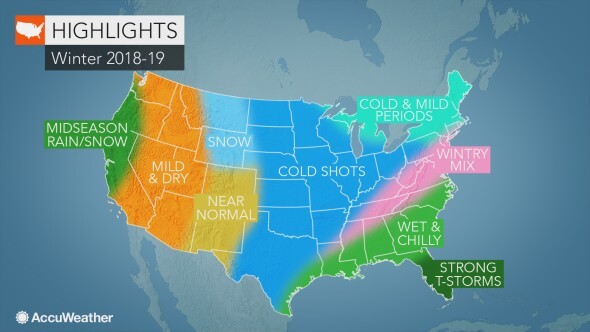
Of course, El Nino cycles vary in intensity and general shape each time they come around, and the one we have coming up is expected to be a substantial one.
Here's what that may mean for golfers in the following regions:
Northeast
Per AccuWeather's first long-range forecast for the season, winter 2018-19 "will start out mild for much of the region before colder weather digs in its heels in January and February." That means golfers in the northeast might see their seasons extended by a few weeks, and there might even be some occasional stretches of unseasonably mild weather that lead to some bonus rounds of golf in certain spots. Otherwise, it'll still be winter, albeit with perhaps less snow than usual.
Southeast
El Nino tends to bring cooler temperatures and a bump in precipitation to the southeastern United States, and this year looks to be no exception. If you take regular winter golf trips to the Carolinas, Georgia and Florida, and you've been putting off investing in some rain gear, now would be a good time to make your purchase. Also, if you can move your trip up by a few weeks, that may be your best bet at avoiding the most pronounced effects of El Nino in this area. "Come late winter," reads the AccuWeather report, "Florida will need to be on alert for severe weather and flooding."
Yikes.
Midwest
Things should play out here similarly to the Northeast, with a milder start to winter, potentially granting area golfers a few more rounds than in most seasons. But the cold snaps will come in January and February, it appears.
Northwest
Here is where a few reports seem to be in conflict. The general consensus appears to be that this region will be a little warmer than normal, but some models predict a significant uptick in precipitation (good for skiiers...not so much for golfers), others seem to herald drier conditions, especially along the west coast. This depends on the extent to which main El Nino-generating waters in the southern Pacific also coincide with warming northern Pacific waters. If this does become a warm and dry winter in the Pacific Northwest, destinations like Bandon Dunes and Bend, Oregon might serve up epic off-season golf days.
Southwest
Here's where things seem to turn around for golfers seeking pleasant winter weather. Per AccuWeather, typical El Nino cycles mean colder, wetter weather in the Southwest, but other factors this year should help it have the opposite effect. According to the report, "Cities such as Flagstaff, Arizona, Albuquerque, New Mexico, and Las Vegas, Nevada, could run as high as 2-4 degrees Fahrenheit above normal." All of those areas have their share of enticing winter golf, so if you've been weighing some different regions for golf trip options, keep that in mind.
Hawaii
If you tune into the PGA Tour's "Aloha Swing," you usually hear a lot of talk of trade winds. Well in El Nino years, those trade winds will die down or even reverse course, facilitating all the big weather changes mentioned so far. But in the Aloha State, close to the epicenter of the action, conditions should also be favorable for golfers: namely, drier than average. If you're taking a Hawaii golf vacation this winter, you may very well get more roll down the fairways and bigger bounces on the greens.
International effects
Another potential short-term benefactor of the coming weather patterns: the British Isles. Typically, when El Nino comes around, it means warmer- and drier-than-usual conditions in Western Europe in the waning months of the calendar year, per the UK's Met Office. Knowing that any golf trip to Ireland, Scotland and England can involve some weather-dodging, especially in the fall, your chances might just be better than usual this year if you're looking to roll the dice on an off-season links golf junket.
Finally, the Caribbean. In brief, El Nino tends to add more precipitation to the winter, which is typically the dry season in this part of the globe. Big temperature changes are unlikely, but make sure you bring an umbrella that will cover more than the top of your cocktail glass.
Remember - forecasts are not set in stone
Any golfer who's been betrayed by a faulty weather forecast (which, I assume, is every golfer) knows that this is a pretty inexact science. Still, the predictions about El Nino this year seem more confident than the ones about last year's potential for a La Nina. More refinements to the forecast are still to come, so hopefully the next news is less threatening to your prospective golf plans.



Comments (4)
newport beach calif appears to be on the border on the map. what does that mean?
looking at the map i think newport beach calif is on the border. what does that usually mean?
newport beach calif appears to be on the border on the map. what does that mean?
looking at the map i think newport beach calif is on the border. what does that usually mean?
Fabulous analysis by Tim! The suggestions on where to play reflects tremendous insight. His thoughts are supported by Weather Trend International's forecasts calculated 11-months in advance that are 83% accurate.