


 Back
Back






Here's a golf course architecture-related hot take for you: as a genre, island greens stink. They're lazy, crummy golf holes with little value except for marketing or social media purposes. More often than not, they are more of a distraction than an attraction, an empty gimmick, deeply unserious.
The run-of-the-mill island-green par 3 is an exercise in pandering. It's a photo op with a short iron in hand, a one-note tune devoted to rote execution. Either you hit a solid shot that stays out of the water, or you don't, and you're down a couple of shots and a golf ball.
While par 3s are inherently not the most strategic of holes to begin with, island greens strip them of all intrigue beyond the main do-or-die proposition. They rub out any possibility for a thrilling recovery shot. And because their basic difficulty is so blatant, architects generally make island green par 3s' greens underwhelming in the extreme. All challenge, no charm.
Island-green par 3s look goofy, too. The vast majority of them are one-off set-pieces that center around a manmade pond plopped in the middle of a course routing that (hopefully) otherwise deftly uses the movement of the terrain to give golfers something of a coherent playing experience. Many golf courses require the digging or enlarging of a pond or lake in order to provide water for irrigation. Many architects use this pond as an island green opportunity. Developers eat them up, plastering them across magazine (remember them?) and digital ads.
There you have it: island greens are bad. Except for one.
Number 17 at TPC Sawgrass' Players Stadium course, host of The Players, is one of the only truly good island-green par 3s thanks to a mix of tangible and intangible advantages that will forever set it above and apart from the field of mostly dreary and derivative pretenders.

Seventeen at Sawgrass was born out of a mix of happenstance and convenience. During the construction of the course, virtually the only sandy portion of a property so swampy and worthless that the PGA Tour bought it for $1 just happened to be where that iconic short hole now sits. Construction crews dug ever deeper, finding more sand that came in handy for shaping other parts of the course, until the area beside what is now the 16th green was a deep pit. What was originally intended to be a less dramatic short one-shotter with a small pond next to it became an island when architect Pete Dye's wife and frequent collaborator, Alice, encouraged him to go all-in on the idea, inspired by a hole at the Ponte Vedra Inn & Club up the road.

As a result, that handful of acres became holy golf ground. The hole works both as a stadium-within-the-Stadium and as a functional piece of golf architecture. The green is actually decently sized, but the glassy pond shrinks it uncomfortably. The crooked heart-shaped green is interesting unto itself, with distinct high middle, low front and low back-right sections. There is more charm found in the way in which hole 17 shares its lake with the reachable par-5 16th. The experience of the island green hole actually begins when a golfer arrives in the landing area on 16 and cannot resist looking ahead to the par 3. That anticipation complicates an already interesting approach shot into the par 5. This is what makes Pete Dye's courses so brilliant and inscrutable: a level of psychological engagement that other architects almost never develop. Because of its provenance and its context, the 17th at TPC Sawgrass' Stadium course has a great deal to offer.
"Golfers who have played the seventeenth say it's a once-in-a-lifetime experience," wrote Dye in his 1995 autobiography, Bury Me in a Pot Bunker. This is because it is no ordinary island green. It stands alone at the top of the list.

5 other island-green golf holes that don't stink

To be fair, TPC Sawgrass' 17th hole is not the only island green hole I don't loathe. I have encountered a lot of dreck, but there are some other diamonds in the rough that have something more than a gimmick in their favor.

Hole 11 at The Creek - Locust Valley, N.Y. (195 yards)
Among the also-rans, the least offensive island greens tend to be the largest because they offer enough grace to keep from ruining too many rounds. This is one of the first island green holes ever built, at a club founded in 1923 with a course laid out by C.B. Macdonald and Seth Raynor. It earns architecture aficionadoes' admiration in large part because of its massive green, some 85 yards from end to end and 30 yards wide. Even on a windy day, there is room to miss, at least by a bit, and get away with it.
Hole 17 at Secession Golf Club - Beaufort, S.C. (130 yards)
Secession is one of the best golf clubs in the South, with a fantastic golf course that is a joy to walk. It meanders along huge expanses of marsh and culminates with a nerve-fraying short par 3 whose green sits atop wooden bulkeads, surrounded by waving grasses. What makes it work is that the shot itself is short enough to be manageable in the wind, and the fact that there are actually recovery shot possibilities from the mud and grass surrounding the putting surface. It is a unique island green with genuine recovery options.
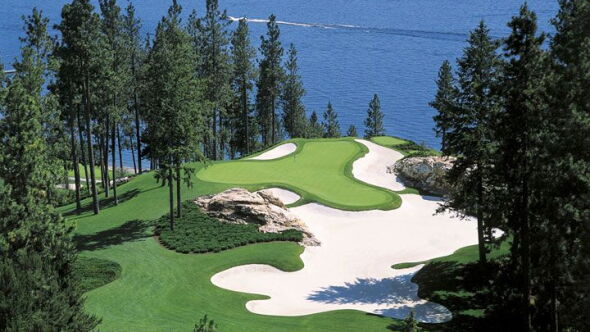
Hole 14 at Coeur d'Alene Resort Golf Course - Coeur d'Alene, Idaho (up to 218 yards)
This hole, made famous on countless magazine spreads and golf computer games in its 35 years of life, takes the gimmick aspect of island greens far enough that it has a kitschy charm. The floating putting surface is only reachable by boat, can be moved around to different distances and floats in the midst of a 50-square-mile lake, blending the natural with the slightly absurd. By leaning into its oddness, it works.
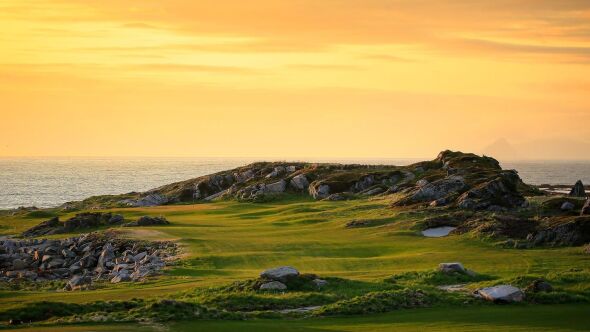
Hole 2 at Lofoten Links - Gimsøysand, Norway (150 yards)
An image of this short hole, with its green on a rocky islet and the Northern Lights playing in the background, has helped Lofoten become something of a golf pilgrimage spot in continental Europe in recent years. Now that it's part of the Cabot orbit, it is likely to pull more golfers north of the Arctic Circle for a summer round.
Hole 15 at TPC Scottsdale (Stadium) - Scottsdale, Ariz. (par 5, 553 yards)
As mediocre as most island-green par 3s are, par 4s and 5s that employ the feature might be even worse. I have never seen an island-green par 4 worth a darn, but the 15th at TPC Scottsdale has earned my respect from afar, as the green complex seems to be of a good size to introduce some danger when a PGA Tour player takes it on in two during the annual WM Phoenix Open. Enough rounds have come undone there that it qualifies as a compelling hole. I haven't played it yet, but I would like to.





Comments (0)