


 Back
Back






KEY BISCAYNE, Fla. - I'll play any golf course once, but it takes a little something extra to get me excited to play somewhere a second time. In the years since I first played it in 2019, I have noticed that I tend to bring Crandon Golf at Key Biscayne up in golf-nerd conversations. Clearly something about the place had gotten under my skin.
I think I know why: Crandon is That '70s Golf Course. You're not going to find bell-bottoms or hear disco music at the layout just a causeway away from downtown Miami. But you will find long runway tees, squiggly bunkers and mounds propping up greens on a beautiful but dead-flat tropical parkland site.
In other words, it fully embodies almost the exact opposite approach from the new golf courses being built today. And that's precisely why I think it's worth playing, and why its somewhat forgotten architect is someone any avid golfer needs to know about.
Crandon's Hollywood architect

Although tobacco advertising has been banned in some form since 1971, the image of the "Marlboro Man" - a roguishly handsome cowboy roaming the West with a cigarette dangling from his lips - will always be part of Americana. Robert von Hagge, a blond-haired Indianan with movie-star looks, was the Marlboro Man for a time. He would also become one of modern golf course architecture's most interesting characters. Along with Australian pro and eight-time PGA Tour winner Bruce Devlin (a frequent collaborator), von Hagge laid out Crandon, which opened in 1972.
The son of a golf course superintendent who had worked for Donald Ross, von Hagge got his own start in the business working for Dick Wilson on courses like Pine Tree in Boynton Beach and Doral in Miami. Establishing his own practice in 1962, he made his own mark in South Florida when he was commissioned to lay out the exclusive Boca Rio Golf Club's course in 1967.
Boca Rio features countless mounds that added what von Hagge termed "vertical expression" while also serving a functional purpose: burying debris that accumulated during the clearing of the site, including invasive Brazilian pepper trees. Its bunkering and greens have distinctly amoeba shapes, while many of the tee areas are long, narrow and straight "runways," a feature midcentury architects like Wilson and Robert Trent Jones, Sr. also employed.

Stateside, von Hagge built most of his courses in Florida and Texas but also worked as far west as California and as far north and east as Massachusetts. He also seized opportunities to expand his business internationally, becoming a globe-trotting midcentury golf course architect in the same vein as the prolific Robert Trent Jones, Sr. He built golf courses in Mexico, continental Europe, Japan and even Australia. Among his most famous international designs is the original course south of Paris at Les Bordes, which he laid out for Baron Marcel Bich, co-founder of the Bic pen and razor empire. Von Hagge also co-designed longtime French Open, 2018 Ryder Cup and 2024 Olympic host Le Golf National. By the time he passed away at the age of 83 in 2010, von Hagge had worked on more than 250 golf courses.

The style in which von Hagge and many of his contemporaries built golf courses was at odds with the philosophies of the great pre-World War II architects, whose influence on architecture has been carried forward by today's crop. Where many latter-day courses favor an approach that moves as little earth as possible or aims to make sites look relatively undisturbed, von Hagge's courses are often inescapably man-made, with profuse mounding and flashy bunkers with smooth, curved edges, in contrast to today's rugged, irregular and chunked-out forms. Rather than looking like they've been there forever, many midcentury-modern golf courses leave golfers with a sense that the site has been manipulated specifically for golf.
A second look at Crandon Golf on Key Biscayne
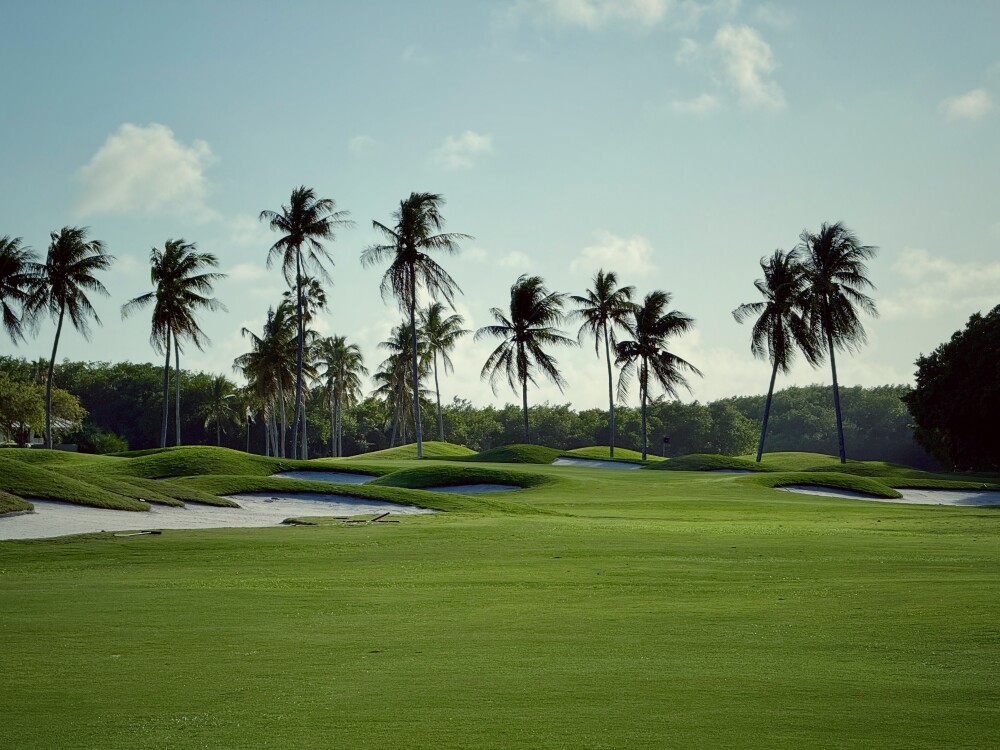
When I learned that the next GolfPass Academy Tour - a GolfPass+ members-only clinic with our world-class instructors, followed by a round of golf - would take place at Crandon, I invited myself along, partly to see whether my fondness for the place at first sight would hold up seven years - and several dozen new golf courses played - later.
Candidly, my own tastes in golf courses tend to skew more traditional. I admire the sensitivity with which architects like Tom Doak, Bill Coore & Ben Crenshaw and Gil Hanse & Jim Wagner work the land on which they operate, especially on sites with tremendous existing natural topography and features.
But I also really like Crandon, not in spite of its differences but because of them. A minimalist approach would not have gotten von Hagge and Devlin far here. They needed to create visual interest where they could, and they succeeded. The bunkering is generously sized and sculpted in a way that helps it stand out within vistas across long stretches of flattish terrain. The greens have a sleekness to them, both in shape and undulation, in an interesting contrast to the more knobby and abrupt contouring style that today's architects use. And while there is some water in play, it is not overbearing. There are just three true forced water carries on the entire course. Crandon is a little on the longer side from most tees, but there is room to play and plenty of opportunity to be rewarded for making good swings.

A strong back nine and an overall strong set of five par 3s are Crandon's design strengths. The one-shotters range from the short, volcano-green 8th to the imposing 17th, which can tip out at more than 240 yards. The best of them is the 12th, with a long angled green fronted by water, with bunkers and tall mounds as its backdrop. It is a quintessential Robert von Hagge hole: sculptural rather than naturalistic but functional as a compelling test of one's long-iron game.
The main criticism of Crandon's design is something it shares with the majority of courses of its era: that the bunkering is more penal than strategic in nature. Fairway bunkers flank landing areas, rather than intruding on them and prompting decisions off the tee. Banging away with driver is a little too obviously the play on most par 4s and 5s at Crandon. A decent mix of green sizes and orientations makes for a good test of approach play, although a slight overreliance on bunkers takes a little bit of variety away.
Crandon is coming off of a $5 million update funded by Golf Miami-Dade, which operates the course within America's third-largest county parks system. Summer 2024 brought a new irrigation system and renovations to the bunkers and tees, as well as the introduction of Paspalum turf that should be a long-term agronomic help.
Overall, Crandon is a breath of fresh air, and a golf course I was glad to battle brutal Miami traffic to see a second time. Visiting golfers who want a true local golf experience should play it. The late afternoon brought dozens of local kids to the practice facility and course. They're lucky to call a golf course like Crandon home. I will be ready for another round there myself before too long.


For future opportunities to learn in-person from our world-class golf instructors and then play interesting golf courses like Crandon, please consider becoming a GolfPass+ member.



Comments (0)