


 Back
Back






In his traditional Wednesday press conference leading up to the 2026 Masters, Augusta National Golf Club chairman Fred Ridley reaffirmed a desire to see golf equipment - the golf ball, particularly - further regulated by the game's governing bodies.
"Until recent years golf has been a game of imagination, creativity and variety. The game has become much more one-dimensional," Ridley said. "As players drive the ball prodigious distances and routinely hit short irons into par-4s and even some par-5s, this issue goes beyond competitive impacts. "
Among other topics more specific to professional golf's first major championship of the year, Ridley once again commented on the issue of distance creep in elite competitive golf, stemming from increasingly potent golf balls and drivers that has resulted in a driving distance increase of nearly 40 yards on the PGA Tour since 1993. In that same period, the championship length of Augusta National Golf Club's course has increased by more than 600 yards, to a 2026 Masters tournament total of 7,565 yards.
Inevitably, longer golf courses create a slower pace of play, which Ridley observes as an added concern around distance creep in golf. "Increased course length results in more time, more cost, and more environmental concerns," Ridley said.
Debate over golf ball and club regulation has raged in recent years, with equipment manufacturers, many pros and rank-and-file golfers arguing against it, expressing concerns that reducing distance could hurt the game's recent popularity. In the meantime, countless golf courses have spent millions of dollars on architectural and maintenance updates aimed in part at combating drives of 350 yards or longer, which are being seen not just at the PGA Tour level but all levels of professional and elite amateur golf.
"We will continue to make modifications as are necessary to react to driving distances that, in some cases, exceed 350 yards."
— Golf Channel (@GolfChannel) April 8, 2026
Fred Ridley speaks on the golf ball rollback. pic.twitter.com/J49TLzHIRl
The significant increase in driving distance has prompted drastic measures in order to maintain the architectural integrity of the world's most famous golf course. In 2017, Augusta National paid Augusta Country Club an undisclosed sum for several acres of club property, prompting its neighbor to shift and rebuild its par-4 9th hole nearly 100 yards to the left. Among other things, this enabled Augusta National to lengthen its famed par-5 13th hole from 510 to a maximum length of 545 yards via the construction of a new championship tee box.
Lengthening the hole was meant to restore the risk-reward proposition of the second shot, played off of a hanging lie to a green guarded by bunkers and a tributary of Rae's Creek. What Augusta National founder and legendary amateur Bobby Jones once called a "momentous decision" had been reduced to a mid- or short-iron for most players in recent years.
"I think the hole is now playing more like it was designed to play," Ridley said. "Sure, there are going to be some middle to even -- probably not short irons, but there will be some middle irons played to that hole. But that's not an easy shot in and of itself. But there are going to be more longer irons and even some fairway metals that are played. I think that's the way we want the hole to play."
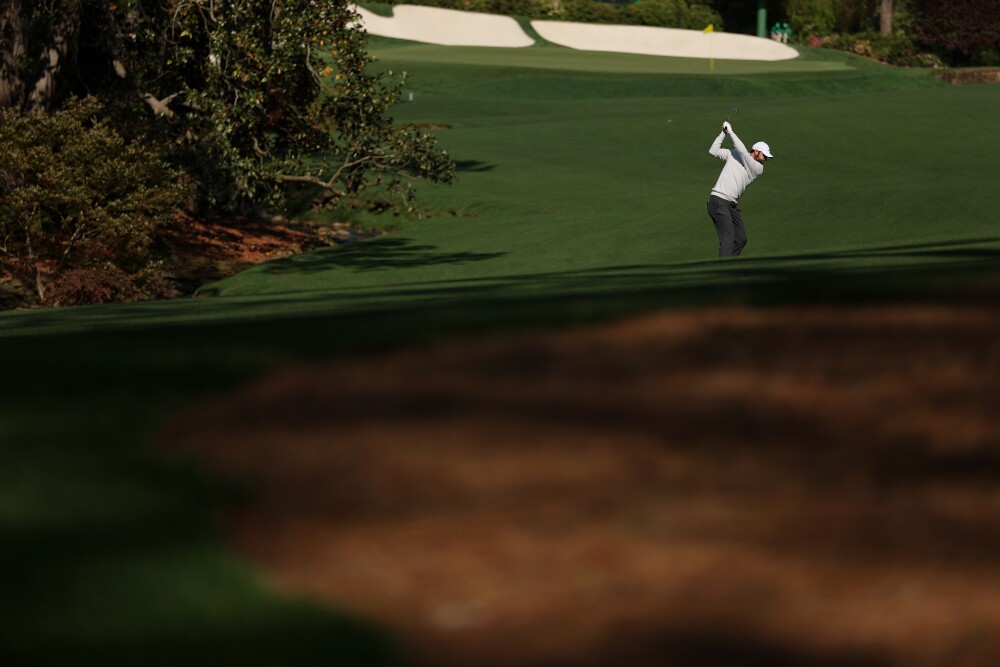
In 2023, the USGA and R&A jointly resolved to adopt new golf ball testing standards aimed at limiting driving distances at the elite levels. They originally planned to institute these new standards for "elite competitions" at the beginning of 2028 before rolling out the new rules of equipment conformity to all golfers in 2030, but recently changed the timeline to 2030 for all golfers everywhere.
In response to fears that higher-handicap golfers could see significant losses in distance, the USGA and R&A have insisted that the longest hitters would see the largest reduction in driving distance - between 15 and 20 yards, at most - while golfers with slower swing speeds would see little to no change.
Ridley echoed that sentiment on Wednesday. "The data that has been shared with all stakeholders makes one thing clear: The impact to the recreational game will be immaterial," he said.
Anecdotal evidence and recent testing of prototypes formulated to comply with future standards would seem to back up the USGA, R&A and Augusta National's claims. Golf Digest published a report that revealed a 17-22-yard loss at PGA Tour-level swing speeds, with a loss of just two yards at lower swing speeds.
Ridley and Augusta National have remained consistent on the subject of golf ball "rollback" and broader regulation of equipment in order to safeguard not just Augusta National but other championship venues like The Old Course at St. Andrews Links, which has had to stretch far-back tees onto other neighboring courses in order to continue to provide a compelling test when it hosts The Open Championship.
Countless other courses have reckoned with increased distance, sometimes having to compromise their designs in order to limit golf balls leaving the property. Lake Worth Beach Golf Course in south Florida has grappled with reducing its third hole, a stout par 4, to a par 3 because more golf balls from the current 3rd tee boxes are leaving the property than at any time in the course's century of history.

Thus far, the golf equipment rollback debate has been a fractious one among golf's largest institutions. While Augusta National, the USGA and the R&A are in agreement about the need for regulation, the PGA of America has been resistant, echoing the sentiments expressed by equipment companies. As for the PGA Tour, past statements by former commissioner Jay Monahan suggested a skepticism in line with that of the PGA of America, but current PGA Tour Enterprises CEO Brian Rolapp's most recent remarks on the subject have suggested more of a wait-and-see approach.
As it pertains to the Masters, one speculated solution has been for Augusta National to require that all contestants use a specific, regulated golf ball during the tournament. The club's power and golf-cultural cachet, as well as the Masters' independent status, make this possible in theory, though it is clear the club, as well as the game's governing bodies, would prefer to see golf equipment regulated at the broad policy level with buy-in from all sides.
"My feeling on this subject is failure's not an option," Ridley said. "I think we need to continue to work together to come to some agreement."





Comments (0)