


 Back
Back






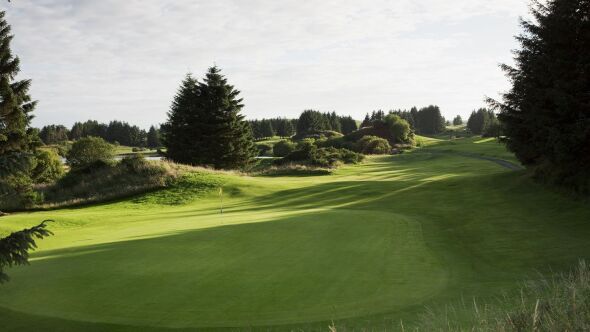
Every day, people can be seen strolling the fairways of the Presidio Golf Course in San Francisco.
No, they're not golfers. There are no clubs involved. Due to the coronavirus pandemic, the Bay Area's shelter in place mandate - said to be extending this week through the end of May - makes sure of that.
The course, located in the Presidio, a national park that is part of the Golden Gate National Recreation Area, has been converted into a public park during this tumultuous time, allowing non-golfing city residents to enjoy the beautiful rolling hills for the first time. Some are savoring the privilege, and going a step further to boldly question why this precious green space doesn't open up to the public for good.
It was intoxicating to be there and consider the possibility of this remaining a park forever. It would be an instant classic, an immense open space in America’s second densest city.
— Zach Klein (@zachklein) April 26, 2020
Malcom Gladwell, the host of the Revisionist History podcast, which aired "A Good Walk Spoiled" episode in 2017 that was critical of golf, piled on with an anti-golf tweet as well, making the game out to be the villain again.
Editor's Note: The course is set to reopen for golfers May 4, a week after this article first published.
Presidio as a park
Klein's series of tweets set off an age-old debate: Why are municipal golf courses in crowded urban areas serving the recreational needs of a relative few instead of many?
In a succession of tweets, he called out all the land taken up by golf on the peninsula, notably the six courses of the San Francisco Recreation & Parks, highlighted by TPC Harding Park (2020 PGA Championship host) and Dr. Alister MacKenzie's Sharp Park in Pacifica. One of them, Gleneagles at McLauren Park, has launched a GoFundMe page to try and keep its temporary COVID-19 closure from becoming a permanent one. There's also a famous foursome of nearby private clubs: The Olympic Club, Cal Club, San Francisco Golf Club and Lake Merced.

It's a misconception to lump Presidio with some of the struggling local munis. The course did 59,000 rounds last year, earning $8.7 million in revenue, according to the park's annual report. The park's hospitality program, which includes golf, two new lodging properties built since 2012, venues and food offerings, made $30.8 million in gross revenue with $5.6 million net income.
I don't blame Klein for wanting more access. It's often an eye-opening experience for a non-golfer to see a course in its natural splendor for the first time. They probably experience some of the same "Oh wow" moments with Mother Nature that attracts golfers to the game - the surprise sighting of a deer, the sheer majesty of the trees, the soft turf, the warming of the soul when the sun pops out from behind the clouds.
But the Presidio is already brimming with open space away from the course to experience those feelings - a 24-mile trail system for hiking and walking, a 25-mile bikeway for cycling and camping and picnic areas. To anyone who insinuates the course - one of the oldest on the West Coast, dating to 1895 - is only available to golfers, isn't considering what that national park already provides.
Is Klein willing to pay $75-$125 for half a day to use the golf course as a park, much like the green fees golfers pay to use the land? I'm guessing that won't fly when there are other free parks nearby.
Golf 'parks' in a pandemic

There is precedent for the debate. The Old Course at St. Andrews in Scotland becomes a public park on Sundays, allowing anyone to walk on golf's sacred ground. The issue is Europe's land-use laws, especially in coastal areas involving links courses. They are significantly different than those in America, skewing toward community access over private use. For example, Scotland has laws for the "Right to roam." A change.org petition to open up U.K. courses as parks during the pandemic has garnered nearly 7,000 signatures.
Liability concerns and property laws make it harder for U.S. courses to follow a similar path. Plus, which of America's urban courses could afford to give back a weekend day of green fees to become a free, accessible park to the general public? For most, it's just not viable.
Could it make sense for the time being, though? It's an issue raised by this Quartz article and gaining steam on social media. Some urban courses currently closed temporarily during the COVID-19 crisis could follow the Presidio's lead by unlocking their gates and let locals enjoy the land. Empty fairways could welcome dog walkers, runners and those looking to "social distance" further away from overrun trails in other popular parks. Maybe the goodwill of the gesture would be appreciated by the new users and possibly pique their interest in the sport that normally takes place there.
The problem is people who don't appreciate the grounds. Several courses overseas are reporting vandalism and abuse while their courses are closed, none worse than this joyriding crew of motorbikes at Walton Heath, a former Ryder Cup venue in England.
Unfortunately, as you may have seen, Sunday at around 18.45, we were subjected to vandalism by motorcyclists on the course. This has been taken to the police who are investigating but if anyone has any info, please contact the club or @SurreyPolice. We thank you for your support pic.twitter.com/rRXumDsBRT
— Walton Heath Golf Club (@waltonheath_gc) April 27, 2020
At courses in Scotland, football is being played on the greens by people ignorant to the delicacy of the turf and high cost of maintaining them.
West Kilbride GC 😫 pic.twitter.com/AvBcxSWToc
— DC (@caxton747) April 14, 2020
What non-golfers needs to realize, pandemic or not, is there's a reason golf courses look so pristine. They're manicured daily by hundreds of hours from superintendents and their staff. That costs money, lots of it. If I were a member of a golf course, I wouldn't want strangers trashing the place as a park. Go play park somewhere else.
Should some courses be used as parkland while temporarily closed to golf during the pandemic? Let us know in the comments below.





Comments (28)
Your readers need to know that at the Old Course, and many other Scotland courses, the TOWN owns the land and the GOLF CLUB maintains and runs the course. There's generally a "gentleman's agreement" that the Golf Club will keep the golf fees very reasonable for town residents (the owners) and members, but be able to charge visitors (and golfers from out of country) higher fees to pay for maintenance and to keep members' fees low. The Old Course arrangement included the agreement that the course could be used as a St Andrews public park on Sundays, with the understanding that people would stay off the greens and out of the bunkers and areas requiring maintenance. In Scotland, the home of golf, most people honor those restrictions. In the US, where your fairway is my dirtbike showplace, that's not such a workable arrangement.
Hope you get to play the Old Course some time - it's a fun experience.
https://markspitzerdesigns.wordpress.com/category/golf-scotland/st-andrews-old-course/ and even includes a miniature course that's fun to play -
https://markspitzerdesigns.wordpress.com/category/golf-scotland/the-himalayas/
and a town that's worth a visit as well.
I do not understand why a golf course has to close and become a park when it would be wiser and safer to leave it as a golf course. Golfers have respect for a golf course, are ready to pay to keep the course well maintained and can social distance just as well as anyone using the course as a park. As shown in one video where they are kicking a ball on a green, some "free " park users do not respect the course and as you see on the sideline the spectators are not even keeping a social distance.
Your readers need to know that at the Old Course, and many other Scotland courses, the TOWN owns the land and the GOLF CLUB maintains and runs the course. There's generally a "gentleman's agreement" that the Golf Club will keep the golf fees very reasonable for town residents (the owners) and members, but be able to charge visitors (and golfers from out of country) higher fees to pay for maintenance and to keep members' fees low. The Old Course arrangement included the agreement that the course could be used as a St Andrews public park on Sundays, with the understanding that people would stay off the greens and out of the bunkers and areas requiring maintenance. In Scotland, the home of golf, most people honor those restrictions. In the US, where your fairway is my dirtbike showplace, that's not such a workable arrangement.
Hope you get to play the Old Course some time - it's a fun experience.
https://markspitzerdesigns.wordpress.com/category/golf-scotland/st-andrews-old-course/ and even includes a miniature course that's fun to play -
https://markspitzerdesigns.wordpress.com/category/golf-scotland/the-himalayas/
and a town that's worth a visit as well.
I do not understand why a golf course has to close and become a park when it would be wiser and safer to leave it as a golf course. Golfers have respect for a golf course, are ready to pay to keep the course well maintained and can social distance just as well as anyone using the course as a park. As shown in one video where they are kicking a ball on a green, some "free " park users do not respect the course and as you see on the sideline the spectators are not even keeping a social distance.
Private property is to be respected by non-owners. If a course is privately owned the owners have every right to protect their property. The golfers who play there pay for the maintenance and upkeep through their greens fees. Non-golfers have absolutely no right to set foot on this property and should be prosecuted if they do so. Courses owned by a municipality are part of the public domain since the tax payers 'own' the property. The non-golf usage is harder to control. But, the property, when it is not being used for its intended purpose should still be respected the same as any municipal property would be protected.
No definitely not. There will always be the minority who trash everywhere they go. Members of clubs have paid for thousands of man hours to maintain the condition of their course. Most people respect this but not everyone does.
i would imagine that those golf coarse walkers are too lazy to keep there own space and gardens in tip top condition. there for rely on other people to pay for there enjoyment. same old story no respect for other peoples hard work.time to let the green keepers have the power to march them off the coarse
Couple of things about your article,picture shows horses and riders on the old course,they are not on the fairways they are on a track that leads to the beach where they exercise their horses,it's the track over the eighteenth fairway at st Andrews old course,
Correct that we have the right to roam in Scotland laws,however it is abused by walkers and particularly dog walkers,they have the right of access to go from point a to b,ie to cross land not to wander aimlessly around the course and let their dogs of the leash to chase the wildlife and mess up the bunkers,I have nothing against dog walkers I have two dogs myself so appreciate they need exercise,there are however no shortage of parks and walks in Edinburgh where dog walkers are welcome,
Alan
Give everyone access to your home, your refrigerator, your car, your family members and then perhaps you will truly understand what "private property" means. Once the government convinces you that you can no longer have use of your private property then it is that much easier for them to take it away from you.
The facilities would become campgrounds for the homeless within 24 hours
if you don't golf i see where this is easy to understand , but for the golfers out there we understand the work it take's to maintain this great game of golf that most people could not begin to phantom the work that go's into the ground keepers job and keeping it look this way, so find the park not the golf course for other than golf period.
Anyone else here see a huge disconnect in CA policy when all these people can walk this course (as a "park") yet golfers are not allowed?! Anyone else tired of Draconian government overreach? The question is rhetorical.