


 Back
Back






I'll never get to relive my four years of college, but I can do the next best thing: seek out and play college golf courses, which I find to be among the most underrated places in the game.
And they're only getting better.
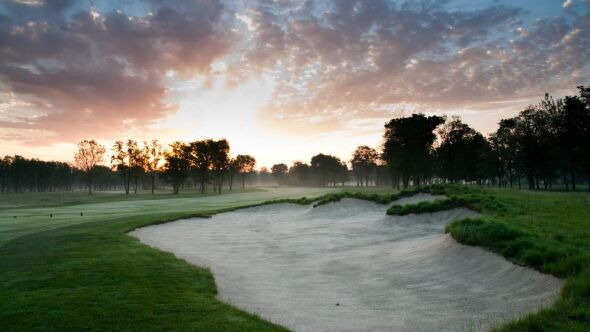
After more than a year's worth of renovation work, Yale Golf Course is set to reopen for play on Tuesday, April 28, 2026. The C.B. Macdonald masterpiece of higher-ed golf is one of the game's most special spots, with as epic an inland playing field as there is in America. Carved out of more than 700 acres, Yale was the most expensive golf course ever built when it opened a century ago, costing more than $400,000 in grass and dynamite to blast through the rocky terrain of southern Connecticut. Its series of template holes include some of the most striking anywhere, including the par-3 9th hole, a Biarritz green with a deep trench running across it. The one-off par-5 18th hole, which has measured more than 600 yards for decades, is one of America's wildest three-shotters.
Even the untrained eye could tell Yale was unique, even as decades of indifferent management kept it from being its best self. After the course inexplicably spent stretches during the COVID pandemic closed receiving zero maintenance while countless other courses thrived, a group of alumni and other donors finally stepped in to invest in one of its greatest assets, hiring architects Gil Hanse and Jim Wagner to do what they have done at several other classic clubs: restore it to its former glory while adding some infrastructure tweaks to keep up with the modern game (e.g. some new back tee boxes).
Yale Golf Course used to be difficult to access for non-members or those unaffiliated with Yale University, but this time around, it will be accessible to the general public, albeit at quite a high maximum green fee of $350. But for a course that has been ranked as one of the world's 100 greatest for decades, and given the skyrocketing costs to play all over high-end daily fee golf, it is not an outrageous sum. The tee sheet is currently open for rounds from April 28 through May 12, with tee times generously spaced at 15 minutes apart.
Yale has extra significance for me personally - it was the first truly great golf course I ever had the chance to play. The scale and wildness of its greens, the mammoth depth of its bunkers and the grandeur of its property hooked me from the beginning. I cannot wait to see it in its new era.
Another college golf course of personal significance and general note that avid players should be excited about is Lexington Golf & Country Club in Lexington, Va. It was my home course throughout my four years at nearby Washington & Lee University, which recently took the place over and hired architect Lester George to renovate it. What was once a quirky, idiosyncratic 6,300-yarder with good bones is set to become a Virginia parkland championship layout that, if all goes well, might just rival Williams College's Taconic Golf Club for the title of "Best Division III college golf course" and might rival UVA's Birdwood and Virginia Tech's River Course for supremacy among college courses in the Old Dominion.
Other college golf course developments are more modest but no less impactful. Back in New England, Stonehill College recently purchased Easton Country Club in South Easton, Mass., a semi-private facility with a course laid out in 1961 by Sam Mitchell. Stonehill already has a Division I women's golf team, and plans to spin up a men's program for the 2027-28 academic year. Just three miles south of the campus, Easton Country Club will give Stonehill students and golf teams a convenient place to practice.
The magic of college golf courses

In my experience, college golf courses tend to have big advantages over run-of-the-mill private facilities. True on-campus courses like the one at Texas A&M are something of a rarity, especially as expansion of colleges' facilities tends to put a squeeze on valuable real estate. I'm not even a college football fan, but standing on the second tee at the A&M course, looking at the largest SEC football stadium, the 102,000-seat Kyle Field, looming beside the fairway, is a memory that sticks with me from my travels. So was a September 2019 round at Trysting Tree Golf Club, home of the Oregon State University golf teams and one of the most perfectly maintained golf courses - public, private or otherwise - I have ever played. Green fees there peak at $65 - a testament to another trait of many excellent college golf courses: affordability.


Comments (4)
Yale should be a bear from the new back tees. It’s a stunning golf course, and the photo you’ve featured shows just how impressive the year’s worth of renovations should be. Having played it several times in college, I can attest to the quality and ingenuity with which this layout is infused. The ninth rivals a landmark Biarritz-like hole, the sixteenth at North Berwick (West) in Scotland. The latter is something of an inverted version: two raised plateau sections of a green with a division—a four-foot swale that parallels Yale's. The eighteenth at Yale is also startling when first encountered and extraordinarily tough to master. When it comes to the top Golden Age architects, nobody does it better. Holding a major championship at Yale would be interesting, even if that sounds fanciful. Great article. And I think David S. has a point. On one occasion, I tried to submit a comment—and failed—that mentioned the second-most legendary bunker at St. Andrews, H*** Bunker at the 14th (four letters, rhymes with “Fell”).
PS: The auto-review needs to be worked on. When I used the word "golfballs" it let me post. However, when I originally tried to post using only the second half of golfballs I was blocked for in appropriate language.
Yale should be a bear from the new back tees. It’s a stunning golf course, and the photo you’ve featured shows just how impressive the year’s worth of renovations should be. Having played it several times in college, I can attest to the quality and ingenuity with which this layout is infused. The ninth rivals a landmark Biarritz-like hole, the sixteenth at North Berwick (West) in Scotland. The latter is something of an inverted version: two raised plateau sections of a green with a division—a four-foot swale that parallels Yale's. The eighteenth at Yale is also startling when first encountered and extraordinarily tough to master. When it comes to the top Golden Age architects, nobody does it better. Holding a major championship at Yale would be interesting, even if that sounds fanciful. Great article. And I think David S. has a point. On one occasion, I tried to submit a comment—and failed—that mentioned the second-most legendary bunker at St. Andrews, H*** Bunker at the 14th (four letters, rhymes with “Fell”).
PS: The auto-review needs to be worked on. When I used the word "golfballs" it let me post. However, when I originally tried to post using only the second half of golfballs I was blocked for in appropriate language.
I learned to play golf on the LG&CC when my dad was a professor at W&L from 1974 through 1978. Our house was on the 6th tee. I made money retrieving golfballs from the 4th pond. Sold them for 50 cents each, 3 for $125.
.